
SlideServe
Menu
Préférences
© SlideServe · v2026

Essential Exam Instructions and Guidelines for Papers 1 and 2

evers avatar
17 diapositives · 293 Views · Oct 22, 2014

This document outlines crucial information regarding the exam dates and structure for Papers 1 and 2. Paper 1 will take place on May 16th (AM) and May 18th (PM), with specific instructions on using black pens and spending appropriate time on questions. It explains the PAF (Purpose, Audience, Form) framework essential for responses and describes the writing techniques required, such as PEE chains for evidence-based answers. Paper 2 focuses on poetry and informative writing, offering guidance for effective examination responses.
Essential Exam Instructions and Guidelines for Papers 1 and 2 - slide 1
01 / 17Essential Exam Instructions and Guidelines for Papers 1 and 2
1 / 17

Télécharger la présentation

Essential Exam Instructions and Guidelines for Papers 1 and 2
Une image / un lien ci-dessous est fourni (tel quel) pour télécharger la présentation

Politique de téléchargement : le contenu du site vous est fourni TEL QUEL pour votre information et votre usage personnel ; il ne peut être vendu, concédé sous licence ni partagé sur d’autres sites sans l’accord de son auteur.Le contenu vous est fourni TEL QUEL, pour votre information et votre usage personnel uniquement. Téléchargez la présentation en cliquant sur ce lien. Lors du téléchargement, si vous ne parvenez pas à télécharger une présentation, l’éditeur a peut-être supprimé le fichier de son serveur.Pendant le téléchargement, si vous ne parvenez pas à obtenir une présentation, le fichier a peut-être été supprimé par l’éditeur.

F I N

Plus de contenu associé

Transcription de la présentation
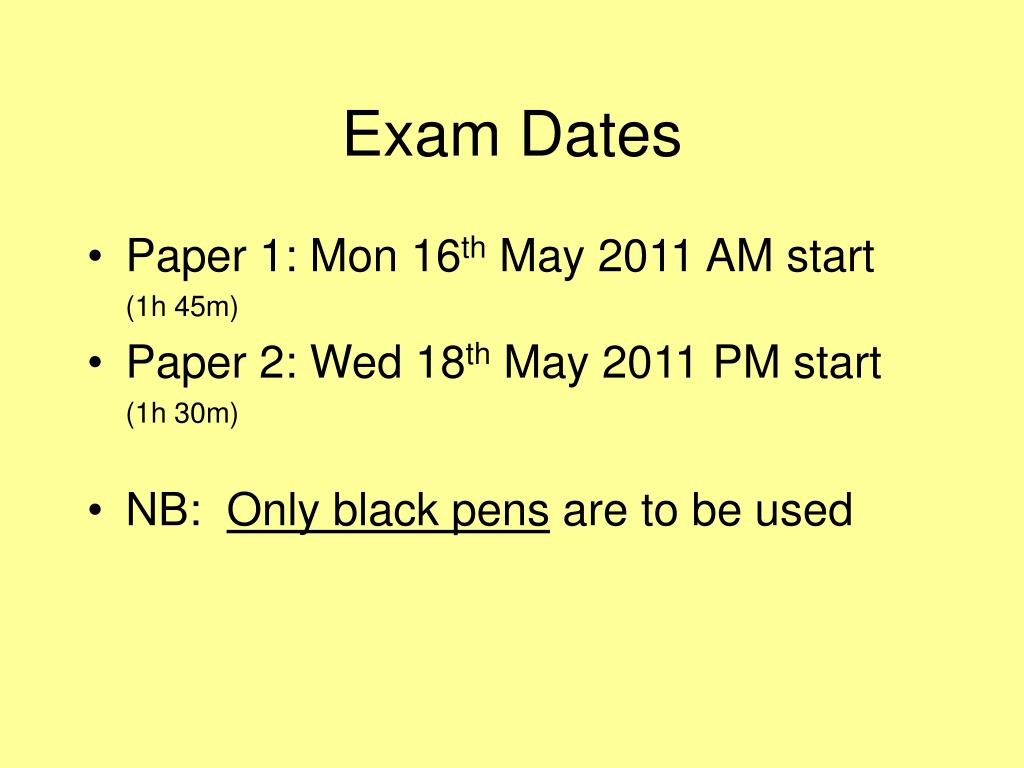
  1. Exam Dates • Paper 1: Mon 16th May 2011 AM start (1h 45m) • Paper 2: Wed 18th May 2011 PM start (1h 30m) • NB: Only black pens are to be used

  2. PAF • P = Purpose (what is the purpose of the text? To inform, to explain, to persuade etc) • A = Audience (who is the text aimed at?) • F = Form (how has the text been presented? A letter, a speech, an advert etc) (therefore it is essential that your son/daughter are reading lots and from a wide range of materials!)

  3. Paper 1 Section A • Reading for meaning (media). There will be 3 connected (similar theme) but different texts to read. • Spend 1 hour on this section. • Answer all questions. • If a question is worth 6 marks you will need to spend approximately 12 minutes on answering it. It should contain a minimum of 3 PEE chains.

  4. What are PEE chains? • P = Point (what point are you making? How/why…) • E = Evidence (find suitable evidence by way of quotation to support your point) • E = Explain (how does the evidence back up your point. Do not repeat the quotation! Analyse the language/intention behind the words)

  5. What does this look like? • “The key points made in this item are that teenagers may be getting healthier due to a ‘decrease in smokers due to mobile phone use’…Another point made…” C/B = a clear attempt to select • “The article makes key points on the subject and backs them up with research carried out by an anti-smoking group”. D = some awareness

  6. Paper 1 Section B • Writing triplet (Argue/Persuade/Advise) • Remember PAF (This will affect choice of language used and layout of work) • Only need to tackle one question (free choice from a range) • Correct writing features for question being undertaken (to follow) “clear identification with audience/purpose; begins to sustain reader’s response” • A range of punctuation (& not just .,) “generally secure” • A range of sentences types

  7. To Persuade • A • F • O • R • E • S • T

  8. To Persuade • Alliteration/Anecdote • Fact/flattery/forceful phrase • Opinion • Rhetorical question/Repetition • Exaggeration/emotive phrase • Statistics • Triplet/threatening disaster

  9. To Argue • List positives • Order points (most to least important) • Use AFOREST • List negatives • Order the points (most to least important) • Use AFOREST Must show awareness of opposing viewpoint in order to gain a C grade. Sustained awareness and counter argument = B grade.

  10. To Advise • A balanced/neutral piece of writing (no bias) • Verbs to use: might, could, possibly, if you…then…. • Weigh up ‘pros’ and ‘cons’ suggested by the question

  11. You can make it up! • As long as what you’re writing could be real/istic – you should make up facts/opinions etc. • Use info. from section A to help (if appropriate). • Leave time to read through responses.

  12. Paper 2 Section A • Poetry - From Other Cultures • Choice of two questions – answer one only • Compare the poems (how are they similar/different?) “appropriate reference; some aspects of presentation” = C “comment on effects achieved & how; a range of comments” = B • Offer a personal response to the poems • Use PEE

  13. Paper 2 Section B • Writing triplet (Inform/Explain/Describe) • Remember PAF (This will affect choice of language used and layout of work) • Only need to tackle one question (free choice from a range) • Correct writing features for question being undertaken (to follow) • A range of punctuation (& not just .,) • A range of sentences types

  14. To Inform/to Explain • Balanced views (no bias) • Use of 5Ws: who; what; where; when; why (& how) • Ordered writing (chronological)

  15. To Describe • M • A • S • T • S

  16. To Describe • Metaphors • Adjectives • Sensory descriptions/similes • Tone/triplets • Sentence types

  17. Contact: • Dohertyl@stanway.essex.sch.uk