Explore the Wonders of Our Solar System with Julie Dort
Discover the fascinating elements of our solar system, including the sun, nine planets, and more. Each planet's unique characteristics, such as Mercury's proximity to the sun and Earth's life-supporting qualities, are detailed. Learn about the icy comets, rocky asteroids, and the mysterious realm of celestial bodies. This educational resource encourages you to test your knowledge with a fun quiz at the end. Dive into the universe that surrounds us and enrich your understanding of our cosmic neighborhood.

Explore the Wonders of Our Solar System with Julie Dort
E N D
Presentation Transcript
The Solar System By Julie Dort
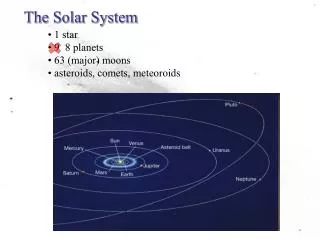
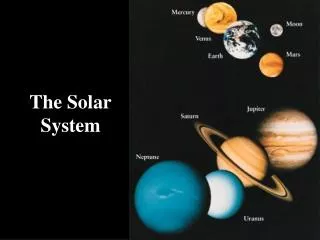
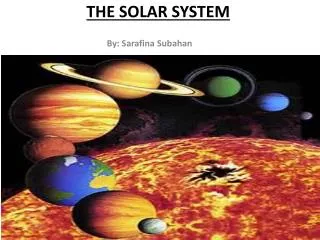
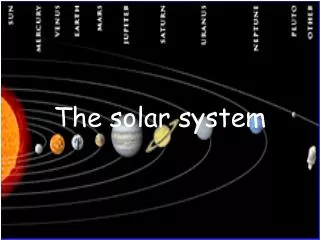
The Solar System • Our solar system consists of: the sun • the nine planets (and their moons) • It also has an asteroid belt, and many comets and meteors.
The Moon • The moon is a cold, dry orb whose surface is studded with craters and strewn with rocks and dust. • The moon dust is called regolith.
SUN • Our sun is a star located at the center of our solar system. • It is a huge, spinning ball of hot gas and nuclear reactions that lights up the Earth and provides us with heat.
Mercury • Mercury is the planet closest to the sun in our solar system. • It is small, rocky planet has almost no atmosphere.
VENUS • Venus is the second planet from the sun in our solar system. • It is the hottest planet in our Solar System.
EARTH • The Earth is the third planet from the sun in our solar system. • It is the planet we evolved on and the only planet in our Solar System that is known to support life.
MARS • Mars is the fourth planet from the sun. • It is about half the size of Earth. • It has a dry, rocky surface and a very thin atmosphere.
JUPITER • Jupiter is the fifth and largest planet in our solar system. • This gas giant has a thick atmosphere, 17 moons, and a dark, barely-visible ring.
SATURN • Saturn is the sixth planet from the sun in our solar system. • It is the second-largest planet in our solar system.
URANUS • Uranus is the seventh planet from the sun in our solar system. • This huge, icy planet is covered with clouds and is encircled by a belt of 11 rings and 18 moons.
NEPTUNE • Neptune is the eighth planet from the sun in our solar system. • This giant, frigid planet has a hazy atmosphere and strong winds.
PLUTO • Pluto is the ninth and usually the farthest planet from the sun in our solar system. • It also the smallest planet in our solar system and the last to be discovered.
COMETS AND ASTEROIDS • A comet is a small, icy celestial body that orbits around the sun. It is made up of a nucleus, a gaseous coma and a tail. • The tail can be up to 250 million km long. • Asteroids are rocky or metallic objects, most of which orbit the Sun in the asteroid belt between Mars and Jupiter
THE SOLAR SYSTEM • Test your knowledge about the solar system by filling out a quiz. • Just click on the check mark and it will take you to the quiz. • Please do not do questions 9, 11, and 15.
Credits: pictures, information and quiz • http://www.EnchantedLearning.com/subjects/astronomy/ • http://starchild.gsfc.nasa.gov/docs/StarChild/solar_system_level1/solar_system.html • http://www.enchantedlearning.com/classroom/quiz/solarsystem.shtml