
Comprehensive Guide to Socket Programming: Client-Server Communication and Select Demo
This guide provides detailed insights into socket programming, showcasing examples of client-server communication in C. It covers key functions like socket creation, binding, listening, accepting connections, and handling multiple clients using the select system call. The practical implementation through demos ensures that readers understand the nuances of handling inputs and outputs, making it an essential resource for both beginners and experienced developers. Dive into the tutorial to explore UDP communication and advanced server management techniques.

Comprehensive Guide to Socket Programming: Client-Server Communication and Select Demo
E N D
Presentation Transcript
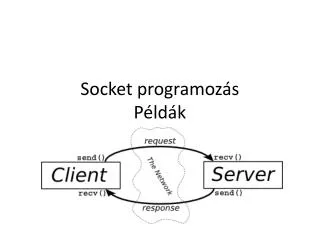
write read Client / Server Session read write EOF read close close Áttekintés Client Server socket socket bind listen Connection request connect accept
Select demo – Beej’s guide #include <stdio.h> #include <sys/time.h> #include <sys/types.h> #include <unistd.h> #define STDIN 0 // file descriptor for standard input int main(void) { structtimevaltv; fd_setreadfds; tv.tv_sec = 2; tv.tv_usec = 500000; FD_ZERO(&readfds); FD_SET(STDIN, &readfds); // don't care about writefds and exceptfds: select(STDIN+1, &readfds, NULL, NULL, &tv); if (FD_ISSET(STDIN, &readfds)) printf("A key was pressed!\n"); else printf("Timed out.\n"); return 0; }
Select demo – Server side … fd_set master; fd_set readfds; int maxfds = sock; FD_ZERO(&master); FD_SET(sock, &master); for(;;) { readfds = master; select( maxfds+1, &readfds, 0, 0, 0 ); for (i=0; i<=maxfds; ++i) { if (FD_ISSET(i, &readfds)) { if (i==sock) { //új kliens akar csatlakozni int conn = accept(i, …); FD_SET(conn, &master); if (conn > maxfds) maxfds = conn; } else { // meglévő klienstől kaptunk üzenetet if ((rbytes=read(i, buf, sizeof(buf)))<=0) { // hiba ha <0 , a kliens bontotta a kapcsolatot ha =0 close(i); FD_CLR(i, &master); // nem figyeljük tovább } else { // kapott üzenet feldolgozása… } } } } }
Select demo – Server side … fd_set master; fd_set readfds; int maxfds = sock; FD_ZERO(&master); FD_SET(sock, &master); for(;;) { readfds = master; select( maxfds+1, &readfds, 0, 0, 0 ); for (i=0; i<=maxfds; ++i) { if (FD_ISSET(i, &readfds)) { if (i==sock) { //új kliens akar csatlakozni int conn = accept(i, …); FD_SET(conn, &master); if (conn > maxfds) maxfds = conn; } else { // meglévő klienstől kaptunk üzenetet if (rbytes=read(i, buf, sizeof(buf))<=0) { // hiba ha <0 , a kliens bontotta a kapcsolatot ha =0 close(i); FD_CLR(i, &master); // nem figyeljük tovább } else { // kapott üzenet feldolgozása… } } } } }
Select demo – Server side … fd_set master; fd_set readfds; int maxfds = sock; FD_ZERO(&master); FD_SET(sock, &master); for(;;) { readfds = master; select( maxfds+1, &readfds, 0, 0, 0 ); for (i=0; i<=maxfds; ++i) { if (FD_ISSET(i, &readfds)) { if (i==sock) { //új kliens akar csatlakozni int conn = accept(i, …); FD_SET(conn, &master); if (conn > maxfds) maxfds = conn; } else { // meglévő klienstől kaptunk üzenetet if (rbytes=read(i, buf, sizeof(buf))<=0) { // hiba ha <0 , a kliens bontotta a kapcsolatot ha =0 close(i); FD_CLR(i, &master); // nem figyeljük tovább } else { // kapott üzenet feldolgozása… } } } } }
Select demo – Server side … fd_setmaster; fd_setreadfds; int maxfds = sock; FD_ZERO(&master); FD_SET(sock, &master); for(;;) { readfds = master; select( maxfds+1, &readfds, 0, 0, 0 ); for (i=0; i<=maxfds; ++i) { if (FD_ISSET(i, &readfds)) { if (i==sock) { //új kliens akar csatlakozni int conn = accept(i, …); FD_SET(conn, &master); if (conn > maxfds) maxfds = conn; }else { // meglévő klienstől kaptunk üzenetet if ((rbytes=read(i, buf, sizeof(buf)))<=0) { // hiba ha <0 , a kliens bontotta a kapcsolatot ha =0 close(i); FD_CLR(i, &master); // nem figyeljük tovább } else { // kapott üzenet feldolgozása… } } } } }
Select demo – Server side … fd_set master; fd_set readfds; int maxfds = sock; FD_ZERO(&master); FD_SET(sock, &master); for(;;) { readfds = master; select( maxfds+1, &readfds, 0, 0, 0 ); for (i=0; i<=maxfds; ++i) { if (FD_ISSET(i, &readfds)) { if (i==sock) { //új kliens akar csatlakozni int conn = accept(i, …); FD_SET(conn, &master); if (conn > maxfds) maxfds = conn; } else { // meglévő klienstől kaptunk üzenetet if ((rbytes=read(i, buf, sizeof(buf)))<=0) { // hiba ha <0 , // a kliens bontotta a kapcsolatot ha =0 close(i); FD_CLR(i, &master); // nem figyeljük tovább } else { // kapott üzenet feldolgozása… } } } } }
Server leállítása void closeServer(int); Int main() { … signal( SIGTERM, closeServer ); … } void closeServer(int sig) { // kilőtték a szervert, //itt tudod elvégezni a leállításhoz szükséges teendőket }
Server - foglalt port sock = socket(…); … int yes=1; setsockopt(sock, SOL_SOCKET, SO_REUSEADDR, &yes, sizeof(yes)); … bind(sock, …);
UDP alapú kommunikáció Forrás:http://publib.boulder.ibm.com/infocenter/iseries/v5r3/index.jsp?topic=%2Frzab6%2Frzab6connectionless.htm
UDP datagram socket Üzenet küldés: • intsendto(intsockfd, const void *msg, intlen, unsigned intflags,conststructsockaddr *to, socklen_ttolen); Üzenet fogadása: • intrecvfrom(intsockfd, void *buf, intlen, unsigned int flags, structsockaddr *from, int *fromlen);
Extra feladat többlet pontok szerzéséhez: • Több felhasználós számológép megvalósítása • (ld. feladatok.txt)