Download

1 / 65
650 likes | 782 Vues
This overview discusses the causes and consequences of the Great Depression, highlighting the false sense of prosperity, rampant speculation, and the resulting stock market crash on October 29, 1929. It addresses the severe economic impacts, such as rampant unemployment and widespread bank failures. The response of President Franklin D. Roosevelt, elected in 1932, is explored through his New Deal programs, designed to provide relief, recovery, and reform. Key initiatives like the Civilian Conservation Corps and the Tennessee Valley Authority demonstrate efforts to revitalize the economy and improve living conditions for millions.

E N D
Causes of the Depression • False sense of prosperity on the part of Americans • Approximately 60% of the population lived in poverty (earning less than $2,000 per year) • Americans were buying on credit; • Resulted in a demand for goods which caused overproduction • Speculation in the stock market • People bought stocks on margin: (10% of value) • Same as borrowing money to pay for stocks
Causes cont. • Speculation led to falsely high stock prices • Stock market began to tumble in the months leading up to the October 1929 crash AND • Speculative investors couldn’t make their margin calls
October 29, 1929 • AKA “Black Tuesday” • Day when the U.S. stock market crashed • Marked as the start of the Great Depression in America • Over a two-day period, the market lost 24% of its value • Other important dates were: • Oct 24, 1929 (Black Thursday) • Oct 28, 1929 (Black Monday)
Bank Failures • Run on America’s banks began immediately following the stock market crash of 1929 • Hundreds of thousands of customers began to withdraw their deposits • Banks had no money to lend • Loans went bad as businesses and farmers collapsed • By 1933, 11,000 of the nation’s 25,000 banks had disappeared
Unemployment • 1929, unemployment was at 3% • 1930, unemployment had jumped to 9%. • 1931, unemployment reached almost 16%. • 1932, unemployment climbed to 24% • 1933, unemployment reached almost 25%. (11 million people without work) • 1934-1937, rate drops to 14%
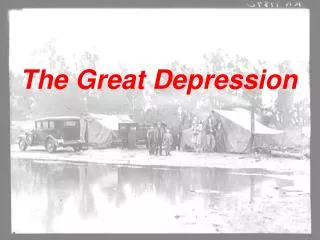
Hoovervilles • Nickname for the shantytowns that spread across the United States • Homeless Americans improvised with scraps, abandoned cars, and packing crates
Dust Bowl 1930-1936 • Farmers over the decades had overplanted and poorly managed their crops • Severe droughts plagued the Great Plains creating the “dust bowl” conditions • Soil turned to dust causing large clouds • Farmers lost their farms and migrated from rural areas to cities • Further complicating the unemployment crisis
FDR and the New Deal • FDR elected in 1932 • Defeats Herbert Hoover • Only 4 term president • Dies near the end of his 4th term • Overcame the challenges of polio • “Fireside chats” over the radio were reassuring to the American people
Vice-Presidents of FDR John Nance Garner Henry Wallace Harry Truman
Three R’s • Relief, Recovery, Reform • Short-range goals were relief and immediate recovery • Long-range goals were permanent recovery and reform of current abuses • FDR was inaugurated on March 4, 1933 • March 6-10,FDR declared a national banking holiday as a prelude to opening the banks on a sounder basis
Cont. • Hundred Days Congress/Emergency Congress (March 9-June 16, 1933) • Pass a series of laws in order to deal with the national emergency • Some of the laws expressly delegated legislative authority to the president
FDR and the Banks • Emergency Banking Relief Act of 1933: • Gave FDR power to regulate banking transactions and foreign exchange and to reopen solvent banks • Glass-Steagall Banking Reform Act: • Created the Federal Deposit Insurance Corporation (FDIC) • Insured individual bank deposits up to $5,000, ending the epidemic of bank failures
FDR Job Programs • Civilian Conservation Corps (CCC): • Provided employment for about 3 million men in government camps • Work included reforestation, fire fighting, flood control, and swamp drainage • Works Progress Administration (WPA): • Construction of buildings, roads, etc • Criticized for paying people to do "useless" jobs such as painting murals
Cont. • Public Works Administration (PWA): • Intended for industrial recovery and unemployment relief • $4 billion on thousands of projects, including public buildings and highways
Tennessee Valley Authority (TVA) • Created by the Hundred Days Congress • New Dealers accused the electric-power industry of gouging the public with excessive rates • 2.5 million of America's most poverty-stricken people inhabited Muscle Shoals, Alabama • Constructing a dam on the Tennessee River in Muscle Shoals did two things: • Put thousands of people to work with a long-term project • Reformed the power monopoly
Effects of the TVA • Brought full employment to the area • Cheap electric power • Low-cost housing • Restoration of eroded soil • Improved navigation and flood control • Area was being turned into one of the most flourishing regions in the United States
National Industrial Recovery Act (NIRA) • Designed to assist industry, labor, and the unemployed • Industries, through "fair competition" codes, were forced to lower their work hours so that more people could be hired • Minimum wages were established • Workers were formally guaranteed the right to organize and bargain collectively through representatives of their choosing
Schechter Poultry Corp. v. United States/1935 • AKA “Sick chicken case” • Supreme Ct. ruled that NIRA was unconstitutional • Court found that the president lacked the power to write the code • All legislative power belonged in the legislative branch • Congress did not have authority to grant the president that exclusive legislative power
Agricultural Adjustment Act(AAA) • Purpose was to balance supply and demand for farm products • Prices would support decent purchasing power for farmers • The concept was known as parity • AAA controlled the supply of seven "basic crops" – corn, wheat, cotton, rice, peanuts, tobacco and milk • Farmers received payments for taking some of their land out of farming by not planting a crop
AAA Cont. • Supreme Ct. ruled the Act unconstitutional • Violated regulatory taxation provisions • Soil Conservation and Domestic Allotment Act of 1936 gave payments to farmers for planting soil conserving crops • Second Agricultural Adjustment Act of 1938 gave payments to farmers if they obeyed acreage restrictions for specific crops
Federal Securities Act • AKA “Truth in Securities Act” • Protected the public against fraud • Requiring promoters to give the investor sworn information regarding the soundness of their stocks and bonds • Securities and Exchange Commission (SEC) • Acts as the watchdog of the stock exchange for illegal activity
Labor Issues • National Labor Relations Act of 1935 (Wagner Act) • Enacted in response to Sup. Ct. ruling the NIRA unconstitutional • Created the National Labor Relations Board • Reasserted the rights of labor to engage in self-organization and to bargain collectively through representatives of its own choice
Labor cont. • Congress passes Fair Labor Standards Act (Wages and Hours Bill) 1938 • Industries involved in interstate commerce: • Required to set up minimum-wage (about .25 cents) and maximum-hour levels • Labor by children under the age of 16 was forbidden
John L. Lewis Founder of the United Mine Workers And Congress of Industrial Organization (CIO) Claimed about 4 million members by 1940