CH 6: Thermochemistry
380 likes | 586 Vues
This resource provides an in-depth exploration of thermochemistry focusing on the concepts of energy, work, and heat transfer. It defines energy as the capacity to do work or supply heat, distinguishing between kinetic and potential energy, and discussing thermal energy related to molecular motion. The principles of heat exchange in chemical reactions, the conservation of energy, and concepts such as enthalpy change and Hess’s Law are also covered. Learn how these fundamental concepts apply to real-world chemical processes and reactions.


CH 6: Thermochemistry
E N D
Presentation Transcript
CH 6: Thermochemistry Renee Y. Becker Valencia Community College CHM 1045
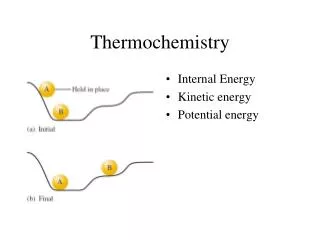
Energy • Energy: is the capacity to do work, or supply heat. Energy = Work + Heat • Kinetic Energy: is the energy of motion. EK = 1/2mv2(1 Joule = 1 kgm2/s2) (1 calorie = 4.184 J) • Potential Energy: is stored energy.
Example 1: KE Which of the following has the greatest kinetic energy? • A 12 kg toy car moving at 5 mph? • A 12 kg toy car standing at the top of a large hill?
Energy • Thermal Energy is the kinetic energy of molecular motion • Thermal energy is proportional to the temperature in degrees Kelvin. Ethermal T(K) • Heat is the amount of thermal energy transferred between two objects at different temperatures.
In an experiment:Reactants and products are the system; everything else is the surroundings. • Energy flow from the system to the surroundings has a negative sign (loss of energy). (-E or - H) • Energy flow from the surroundings to the system has a positive sign (gain of energy). (+E or +H)
The law of the conservation of energy: Energy cannot be created or destroyed. • The energy of an isolated system must be constant. • The energy change in a system equals the work done on the system + the heat added. DE = Efinal – Einitial = E2 – E1 = q + w q = heat, w = work
Pressure is the force per unit area. (1 N/m2 = 1 Pa) (1 atm = 101,325 Pa) • Work is a force (F) that produces an object’s movement, times the distance moved (d): Work = Force x Distance
The expansion in volume that occurs during a reaction forces the piston outward against atmospheric pressure, P. Work = -atmospheric pressure * area of piston * distance piston moves
Example 2: Work How much work is done (in kilojoules), and in which direction, as a result of the following reaction?
The amount of heat exchanged between the system and the surroundings is given the symbolq. q = DE + PDV At constant volume (DV = 0): qv = DE At constant pressure: qp = DE + PDV = DH Enthalpy change: DH = Hproducts – Hreactants
Example 3: Work The explosion of 2.00 mol of solid TNT with a volume of approximately 0.274 L produces gases with a volume of 489 L at room temperature. How much PV (in kilojoules) work is done during the explosion? Assume P = 1 atm, T = 25°C. 2 C7H5N3O6(s) 12 CO(g) + 5 H2(g) + 3 N2(g) + 2 C(s)
Enthalpies of Physical Change: Enthalpy is a state function, the enthalpy change from solid to vapor does not depend on the path taken between the two states. Hsubl = Hfusion + Hvap
Enthalpies of Chemical Change:Often called heats of reaction (DHreaction). Endothermic:Heat flows into the system from the surroundings and DH has a positive sign. Exothermic:Heat flows out of the system into the surroundings and DH has a negative sign.
Reversing a reaction changes the sign of DH for a reaction. C3H8(g) + 5 O2(g) 3 CO2(g) + 4 H2O(l) DH = –2219 kJ 3 CO2(g) + 4 H2O(l) C3H8(g) + 5 O2(g) DH = +2219 kJ • Multiplying a reaction increases DH by the same factor. 3 [C3H8(g) + 15 O2(g) 9 CO2(g) + 12 H2O(l)] DH = 3(-2219) kJ DH = -6657 kJ
Example 4: Heat • How much heat (in kilojoules) is evolved or absorbed in each of the following reactions? a) Burning of 15.5 g of propane: C3H8(g) + 5 O2(g) 3 CO2(g) + 4 H2O(l) DH = –2219 kJ/mole b) Reaction of 4.88 g of barium hydroxide octahydrate with ammonium chloride: Ba(OH)2·8 H2O(s) + 2 NH4Cl(s) BaCl2(aq) + 2 NH3(aq) + 10 H2O(l) DH = +80.3 kJ/mole
Thermodynamic Standard State:Most stable form of a substance at 1 atm pressure and 25°C; 1 M concentration for all substances in solution. • These are indicated by a superscript ° to the symbol of the quantity reported. • Standard enthalpy changeis indicated by the symbol DH°.
Example 5: Is an endothermic reaction a favorable process thermodynamically speaking? • Yes • No
Hess’s Law • Hess’s Law:The overall enthalpy change for a reaction is equal to the sum of the enthalpy changes for the individual steps in the reaction.(not a physical change, chemical change) 3 H2(g) + N2(g) 2 NH3(g) DH° = –92.2 kJ
Reactants and products in individual steps can be added and subtracted to determine the overall equation. (1) 2 H2(g) + N2(g) N2H4(g) DH°1 = ? (2) N2H4(g) + H2(g) 2 NH3(g) DH°2 = –187.6 kJ (3) 3 H2(g) + N2(g) 2 NH3(g) DH°3 = –92.2 kJ DH°1 + DH°2 = DH°reaction Then DH°1 = DH°reaction - DH°2 DH°1 = DH°3 – DH°2 = (–92.2 kJ) – (–187.6 kJ) = +95.4 kJ
Example 6: Hess’s Law • The industrial degreasing solvent methylene chloride (CH2Cl2, dichloromethane) is prepared from methane by reaction with chlorine: CH4(g) + 2 Cl2(g) CH2Cl2(g) + 2 HCl(g) Use the following data to calculate DH° (in kilojoules) for the above reaction: CH4(g) + Cl2(g) CH3Cl(g) + HCl(g) DH° = –98.3 kJ CH3Cl(g) + Cl2(g) CH2Cl2(g) + HCl(g) DH° = –104 kJ
Standard Heats of Formation (DH°f): The enthalpy change for the formation of 1 mole of substance in its standard state from its constituent elements in their standard states. • The standard heat of formation for any element in its standard state is defined as being ZERO. DH°f = 0 for an element in its standard state
Standard Heats of Formation • Calculating DH° for a reaction: DH° = DH°f (Products) – DH°f (Reactants) • For a balanced equation, each heat of formation must be multiplied by the stoichiometric coefficient. aA + bB cC + dD DH° = [cDH°f(C) + dDH°f(D)] – [aDH°f(A) + bDH°f(B)]
CO(g) -111 C2H2(g) 227 Ag+(aq) 106 CO2(g) -394 C2H4(g) 52 Na+(aq) -240 H2O(l) -286 C2H6(g) -85 NO3-(aq) -207 NH3(g) -46 CH3OH(g) -201 Cl-(aq) -167 N2H4(g) 95.4 C2H5OH(g) -235 AgCl(s) -127 HCl(g) -92 C6H6(l) 49 Na2CO3(s) -1131 Standard Heats of Formation Some Heats of Formation, Hf° (kJ/mol)
Example 7: Standard heat of formation Calculate DH° (in kilojoules) for the reaction of ammonia with O2 to yield nitric oxide (NO) and H2O(g), a step in the Ostwald process for the commercial production of nitric acid.
Example 8: Standard heat of formation Calculate DH° (in kilojoules) for the photosynthesis of glucose and O2 from CO2 and liquid water, a reaction carried out by all green plants.
Example 9: Which of the following would indicate an endothermic reaction? Why? • -H • + H
Heat of Phase Transitions from Hf Calculate the heat of vaporization, Hvap of water, using standard enthalpies of formation Hf H2O(g) -241.8 kJ/mol H2O(l) -285.8 kJ/mol
Calorimetry and Heat Capacity • Calorimetry is the science of measuring heat changes (q) for chemical reactions. There are two types of calorimeters: • Bomb Calorimetry: A bomb calorimeter measures the heat change at constant volume such that q = DE. • Constant Pressure Calorimetry: A constant pressure calorimeter measures the heat change at constant pressure such that q = DH.
Constant Pressure Bomb
Calorimetry and Heat Capacity • Heat capacity (C)is the amount of heat required to raise the temperature of an object or substance a given amount. Specific Heat:The amount of heat required to raise the temperature of 1.00 g of substance by 1.00°C. q = s x m x t q = heat required (energy) s = specific heat m = mass in grams t = Tf - Ti
Calorimetry and Heat Capacity • Molar Heat:The amount of heat required to raise the temperature of 1.00 mole of substance by 1.00°C. q = MH x n x t q = heat required (energy) MH = molar heat n = moles t = Tf - Ti
Example 10: Specific Heat What is the specific heat of lead if it takes 96 J to raise the temperature of a 75 g block by 10.0°C?
Example 11: Specific Heat How much energy (in J) does it take to increase the temperature of 12.8 g of Gold from 56C to 85C?
Example 12: Molar Heat • How much energy (in J) does it take to increase the temperature of 1.45 x10⁴ moles of water from 69C to 94C?