Respiration
Respiration. Respiration The process by which chemical bond energy in nutrients is used to synthesize ATP Respiration allows for the energy stored in food to be broken down into a form that can be used by an organism.

Respiration
E N D
Presentation Transcript
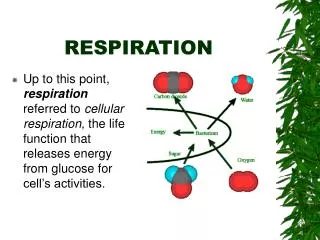
Respiration • The process by which chemical bond energy in nutrients is used to synthesize ATP • Respiration allows for the energy stored in food to be broken down into a form that can be used by an organism. • Respiration is a continuously ongoing process which occurs in almost every cell of an organism
ATP: Adenosine Triphosphate • ATP: • The chemical energy stored in the bonds of ATP is the only usable form of energy for most living organisms • ATP is formed through the process of respiration ADP + P ATP Adenosine Diphosphate Phosphate Adenosine Triphosphate
Energy is released by the process of HYDROLYSIS • The process is catalyzed by the enzyme, ATP-ase • Two different types of respiration • Aerobic: Uses free oxygen • Anaerobic: Does not use free oxygen
During respiration, gasses enter and exit the organism by DIFFUSION across “THE MOIST RESPIRATORY SURFACES (MEMBRANES)” • Complex organisms have developed specialized organs with the purpose of absorbing and transporting gasses • AKA the RESPIRATORY SYSTEM
ANAEROBIC RESPIRATION(AKA: FERMENTATION) • All living cells use anaerobic respiration to break down glucose into a useable form of energy, ATP • The process of anaerobic respiration must always begin with the presence of GLUCOSE • The GLUCOSE is then broken down (Glycolysis) with the aid of ENZYMES into PYRUVIC ACID and then into either: • 2 LACTIC ACID + 2 ATP • 2 Alcohol + 2 CO2 + 2 ATP
Simple BACTERIA and simple ORGANSIMS are unable to carry on aerobic respiration • Yeast are able to perform both forms of respiration, but they are capable of surviving solely on anaerobic in a oxygen poor environment • Muscle cells in more complex organisms perform anaerobic respiration when adequate oxygen is unavailable
Glycolysis Net 2 ATP Fermentation
ANAEROBIC RESPIRATION • RESULTS • Lactic Acid Fermentation results in Muscle fatigue and the “Burn” • Alcoholic Fermentation • Used in Brewing industry (Beer and Wine) • Used in Baking as the result of CO2 Production
AEROBIC RESPIRATION • Respiration that takes place in the presence of OXYGEN • In ANIMALS cellular respiration takes place in the MITOCHONDRIA • In PLANTS, respiration is continuously ongoing regardless of photosynthesis • Chemical Respiration is the SAME in both PLANTS and ANIMALS
Molecules of GLUCOSE are broken down completely into CO2 and H2O • Net gain of 36 ATP per molecule of GLUCOSE • 2 ATP from ANAEROBIC • 34 ATP from AEROBIC
Adaptations for Respiration • Plants • Leaves • STOMATES on the underside of the leaf open and close to allow for gas exchange • Opening regulated by the Guard Cells • Gas exchange occurs by diffusion through cell membranes that are within the spongy layer • Stems • Gases exchanged through LENTICELS, small openings on stem • Roots • Diffusion of gasses occurs through thin moist membranes of ROOT HAIRS
Monera, Protists, and Fungi • Gas exchange takes place by diffusion through thin, moist, cell membranes Because the cell membrane is (IDCWWE) O2 CO2 CO2 O2
Hydra • All cells are in direct contact with watery environment (ACRIDICWE) O2 CO2
Earthworm • Gas exchange takes place through skin • (must be kept moist with mucus) • Uses hemoglobin to more effectively carry O2 through capillaries • Grasshopper • Gasses carried through TRACHEAL TUBES • Gasses enter body though SPIRACLES, small holes in exoskeleton • Air sacks pump air from outside to the moist membranes of the body cells
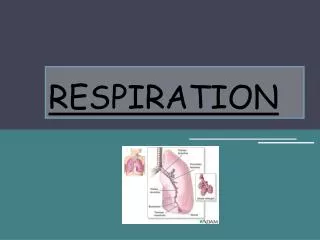
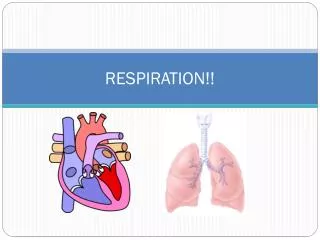
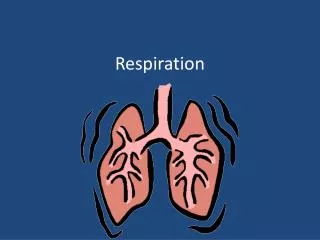
Humans • Nasal Cavity • Air enters the body through the nostrils • Nasal Cavity is lined with CILIA • Cleans, Warms, and Moistens air • Pharynx • Area where oral cavity and nasal cavity meet • Trachea (Windpipe) • Tube connecting the PHARYNX and the LUNGS • EPIGLOTTIS • Flap of tissue that covers the trachea to prevent choking • Larynx (Voicebox)
Walls of TRACHEA contain cartilage rings • CILIATED MUCOUS MEMBRANE traps particles in the air and prevents them from entering the lungs • Bronchi and Bronchioles • 2 BRONCHI branch off from end of TRACHEA, one for each lung • Each BRONCHI then branch into smaller BRONCHIOLES • At the end of the BRONCHIOLES are clusters of small air sacs known as ALVEOLI • Alveoli • Thin, Moist walls, surrounded by capillaries • Site of gas exchange
Respiratory System Disorders • Bronchitis • Inflammation of the lining of bronchial tubes • Air passages narrow and fill with mucus • Asthma • Allergic reaction • Narrowing of bronchial tubes (Allergic Response) • HISTAMINES are released into the body causing the allergic response
Emphysema • Loss of elasticity of walls of Alveoli due to an overexpansion of the Alveoli due to smoking • Smokers cough: results from damage to the cilia lining the trachea • SOB, difficulty breathing, and decreased lung capacity