Download

1 / 7
70 likes | 179 Vues
Water, with its highly polar O—H bonds and bent molecular shape, exhibits unique properties that affect our environment and life. Its high surface tension, low vapor pressure, and significant specific heat capacity (4.184 J/g×°C) are essential for many biological and physical processes. Interestingly, as ice forms, it becomes less dense than liquid water, allowing it to float – a rare property for solids. This behavior arises from its open framework structure at lower temperatures, which decreases density and plays a critical role in aquatic ecosystems.

E N D
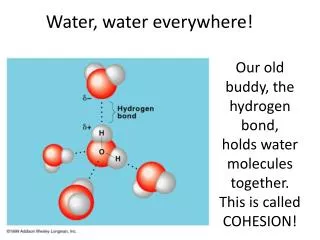
I. Water A. The Molecule 1. O—H bond is highly polar 2. Bond angle 105° making it Bent shaped 3. Water Molecule as a whole is polar 4. Attracted to each other by intermolecular hydrogen bonds Greater electronegativity
I. Water (cont.) B. Important Properties 1. High surface tension 2. low vapor pressure • hydrogen bonds hold molecules to one another, tendency to escape surface is low 3. high specific heat capacity • 4.184 J/g×°C 4. high melting and boiling points • 0°C and 100°C
I. Water (cont.) C. Surface Tension – inward force, or pull, that tends to minimize the surface area of a liquid • Surfactant – wetting agent such as soap or detergent that decreases the surface tension by interfering with hydrogen-bonding Responsible for high surface tension
I. Water (cont.) D. Atypical Ice 1. As a typical liquid cools, density increases b/c Volume decreases as the mass stays constant 2. As water cools it first behaves like a typical liquid until it reaches 4°C 3. Below 4°C the density of water starts to decrease **Ice is one of only a few solids that float in their own liquid.
Atypical Ice Why does ice behave do differently? Open framework arranged like a honeycomb. Framework collapses, molecules packed closer together, making it more dense