
Improved Measurement of f3 Using GLW, ADS, and GGSZ Observables in B Decays
This study focuses on the analysis of decay channels like B→D*K and B→DK through the combined usage of GLW (Gronau-London-Wyler), ADS (Atwood-Dunietz-Soni), and GGSZ (Gronau-Grossman-Sonozi-Zupan) observables to enhance the precision of f3 measurement in CKM matrix elements. By leveraging data from Belle and BaBar experiments amounting to hundreds of millions of B meson decays, we aim for a combined sensitivity of 10-20° to obtain improved results this summer. Advanced methods, including NeuroBayes for qq suppression and simultaneous fitting strategies, will enrich our analysis.

Improved Measurement of f3 Using GLW, ADS, and GGSZ Observables in B Decays
E N D
Presentation Transcript
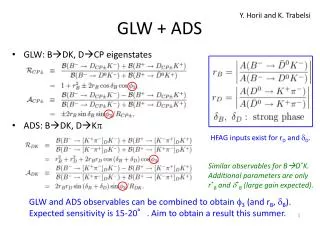
GLW + ADS Y. Horii and K. Trabelsi • GLW: BDK, DCP eigenstates • ADS: BDK, DKp HFAG inputs exist for rD and dD. Similar observables for BD*K. Additional parameters are onlyr*B and d*B (large gain expected). GLW and ADS observables can be combined to obtainf3 (and rB, dB). Expected sensitivity is 15-20°. Aim to obtain a result this summer.
Y. Horii Status for ADS Belle: DK (772M BB, submitted to PRL) BaBar: DK+D*K (467M BB), DK* (379M BB), D(Kpp0)K (226M BB) CDF: DK (5 fb-1) D*K ADS will provide additional information for f3. Will analyze D*K ADS for this summer. (Expected yield ~20 events.)
Y. Horii Calibration modes for D*K ADS are well reconstructed (Exp.7-65, Case A). D*(Dp0)p D*(Dp0)K BR(D*K)/BR(D*p) = 0.079 ± 0.006 Dh Dp D*(Dg)p D*(Dg)K BR(D*K)/BR(D*p) = 0.081 ± 0.009 Dh Dp PDG D*K/D*p = 0.080 ± 0.007 Will use case-B samples. Will include a qq suppression using NeuroBayes (2-D fit on DE and NB). Hopefully apply simultaneous fit to DK and D*K.
GLW + ADS +GGSZ Y. Horii + K. Trabelsiwith A. Poluektov (?) An improved measurement of f3 can be obtained from “GLW + ADS +GGSZ.” Observables for GGSZ: ±stat ±syst ±syst(model independent) Since x± and y± are functions of f3, rB, and dB (same as GLW and ADS),we can combine the observables for GLW, ADS, andGGSZ. The correlations for x± and y± can be handled by using experimental likelihoods. Expected sensitivity ~ 10°.