Periodic Trends
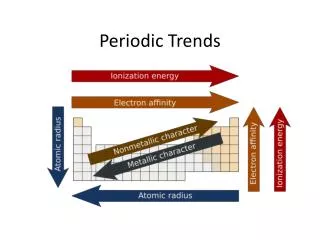
Explore the key factors influencing periodic trends in the periodic table, focusing on atomic size, ionization energy, electronegativity, and electron affinity. Learn how energy levels, nuclear charge, and the shielding effect contribute to changes in these properties across periods and groups. As you move from left to right in a period, atomic size decreases, ionization energy and electronegativity increase, while the opposite trend occurs down the groups. Understanding these trends is fundamental in chemistry and helps predict atom behavior in reactions.


Periodic Trends
E N D
Presentation Transcript
ALL Periodic Table Trends • Influenced by three factors: 1. Energy Level • Higher energy levels are further away from the nucleus. 2. Charge on nucleus (# protons) • More charge pulls electrons in closer. (+ and – attract each other) • 3. Shielding effect- Outer electrons shielded from influence of nucleus
Atomic Size • Atomic radius – one half the distance between the nuclei of two atoms of the same element
Leaving the noble gases out, atoms get smaller as you go across a period. Electrons are in the same energy level. But, there is more nuclear charge. The electrons are pulled closer.
As we go down a group, each atom has another energy level, so the atoms get bigger.
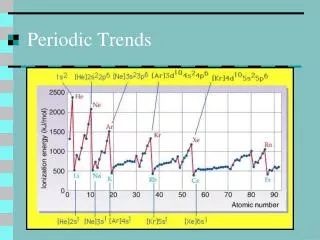
Ionization Energy • Energy required to remove an electron • IE increase from left to right across PT • The greater the nuclear charge, the greater IE, because …… • All the atoms in the same period have the same energy level. • Same shielding. • But, increasing nuclear charge
IE decreases down a group because • Greater distance from nucleus decreases IE . • The electron is further away from the attraction of the nucleus, and • There is more shielding.
Electronegativity (EN) • the ability of an atom to attract electrons when the atoms is in a compound • Metals have low EN • Non-metals have high EN
Electronegativity increases from left to right across a period(Noble gases have no EN) • Because the greater nuclear charge attracts electrons.
EN decreases as you go down a group. • because the farther away the electrons is from the nucleus, the more likely an atom is to lose an e- than gain an e-. • Shielding makes it more difficult to attract e-.
Electron Affinity • Energy required to add an electron • Two cases: • Atom + electron ion + energy (exothermic) • Atom + electron + energy ion (endothermic)
Ionic Radii • Ions – charged particles