Understanding Translational Equilibrium of Forces: Examples and Calculations
This guide explores the principles of translational equilibrium, where a system moves in a straight line at constant speed or remains at rest. It discusses how to use the graphical method of vector addition to analyze forces acting on bodies, ensuring that resultant forces in perpendicular directions are zero. Examples include a skier on a slope, tension in hanging strings, and a mass over a pulley. Each scenario illustrates equilibrium conditions, calculations of frictional forces, tension, and normal forces, fostering a deeper understanding of static and dynamic systems.

Understanding Translational Equilibrium of Forces: Examples and Calculations
E N D
Presentation Transcript
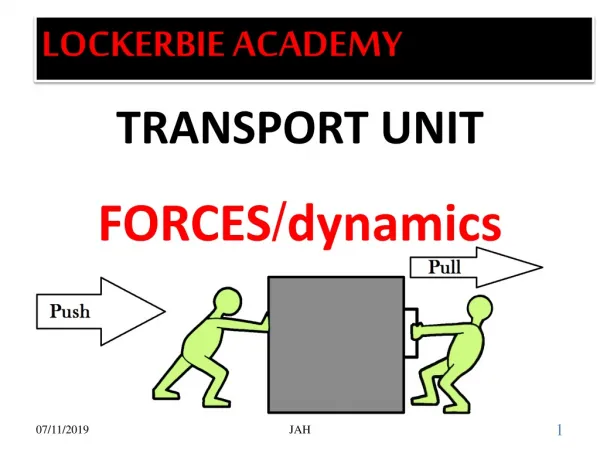
Forces and Dynamics Equilibrium of Forces
Equilibrium of Forces Translational Equilibrium If every part of a system moves in a straight line at a constant speed, we say it is in translational equilibrium. This includes being at rest. This means that using the graphical method of vector addition for the forces acting on the body, always produces a closed loop: For a body to be in translational equilibrium, the resultant forces in any two perpendicular directions must be zero
E.g. 1 A skier moving at constant speed down a piste: i. Situation Diagram: ii. FBFD for skier: Gravitational force from Earth on skier Frictional force from Earth on skier Contact force from Earth on skier
Gravitational force from Earth on skier Frictional force from Earth on skier Contact force from Earth on skier
50kg m 30° E.g. 1A 50kg mass on a slope. Friction prevents it from moving. Determine the frictional force. FBFD for m: N F 30° mg Equilibrium parallel to slope: mg sin30 – F = 0 0.5 x 50 x 10 – F = 0 F = 250N m 30°
50° 50° 5kg E.g. 2 A lamp of mass 5kg hangs from two strings, each at an angle 50° to the vertical as shown. Calculate the tension in the strings. Considering vertical equilibrium: T cos50 + T cos50 – 49 = 0 0.64 T + 0.64 T = 49 1.28 T = 49 T = 49/1.28 = 38.3N F.B.F.D: 50° 50° T T 49N Note:In this example the tension is the same in both strings, because they are at the same angle.
10kg m 30° E.g. 3A 10kg mass hangs over a pulley, connected to a stationary mass M on a 30° frictionless slope. If the system is in equilibrium determine m. FBFD for m: N 98N 30° mg Extension: Now determine the normal reaction force by considering equilibrium perpendicular to the slope. Equilibrium parallel to slope: mg sin30 – 98 = 0 0.5 mg – 98 = 0 mg = 196 so m = 20kg m 30°
Subtitle Text
Subtitle Text
Subtitle Text
Subtitle Text
Subtitle Text
Subtitle Text