Comprehensive Risk Assessment for Grezelka Transition Range Operations
This document outlines a thorough risk assessment for the Grezelka Transition Range, addressing various operational hazards such as slips, trips, falls, and live fire ammunition. Each hazard is evaluated based on severity and likelihood, and appropriate control measures are developed. Key issues include proper training for personnel, equipment safety, and facility maintenance to mitigate risks effectively. The assessment categorizes overall risk ratings as low, moderate, or high, emphasizing the importance of adhering to safety protocols and standard operating procedures.

Comprehensive Risk Assessment for Grezelka Transition Range Operations
E N D
Presentation Transcript
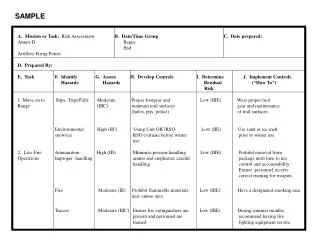
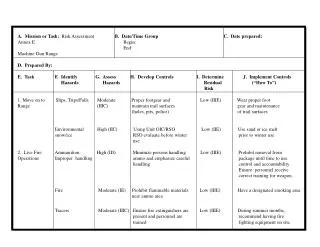
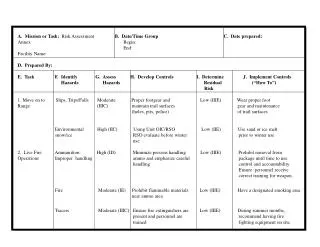
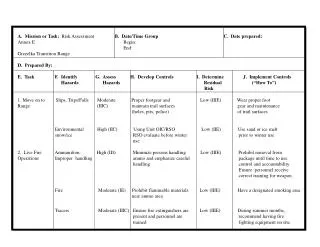
A. Mission or Task: Risk Assessment B. Date/Time Group C. Date prepared: Annex E Begin: End: Grezelka Transition Range D. Prepared By: E. Task F. Identify G. Assess H. Develop Controls I. Determine J. Implement Controls Hazards Hazards Residual (“How To”) Risk 1. Move on to Slips, Trips/Falls Moderate Proper footgear and Low (IIIE) Wear proper foot Range (IIIC) maintain trail surfaces gear and maintenance (holes, pits, police) of trail surfaces Environmental High (IIC) Using Unit OIC/RSO Low (IIE) Use sand or ice melt snow/ice RSO evaluate before winter prior to winter use use 2. Live Fire Ammunition: High (ID) Minimize persons handling Low (IIIE) Prohibit removal from Operations Improper handling ammo and emphasize careful package until time to use. handling control and accountability Ensure personnel receive correct training for weapon. Fire Moderate (IE) Prohibit flammable materials Low (IIIE) Have a designated smoking area near ammo area Tracers Moderate (IIIC) Ensure fire extinguishers are Low (IIIE) During summer months, present and personnel are recommend having fire trained fighting equipment on site. SAMPLE
SAMPLE Malfunction Moderate (IID) Stress misfire and clearing Low (IIIE) Train personnel on procedures proper misfire/clearing procedures. Loaded Weapons High (IIC) Keep weapons pointed up and Moderate (IID) Establish misfire down range at all times procedure and rehearse immediate action drill No horseplay. Weapon cleared on and off range by OIC/RSO. Noise hazards High (IIC) Wear proper hearing protection Low (IIID) Ensure hearing protection is available and worn 3. Exiting Uncleared Weapon High (ID) Weapons must be cleared off the Low (IIE) Require RSO or OIC to clear Range range by the RSO or OIC all weapons NOTE: Control measures will be briefed and incorporated into the SOP. Supervision and training to standard are key to mission success. The Range Safety Officer, OIC and any other safety personnel will ensure that these control measures are implemented, the SOP is adhered to, and high standards of safety are maintained at all times to ensure risks are minimized. All personnel will be briefed on the control measures, emergency procedures and review lessons learned from previous accidents prior to training. Emergency procedures will be rehearsed, to include, simulating calling, contacting Range Control, directing immediate cease fire, etc. RISK ASSESSMENT RATING: The overall rating given to the Grezelka Transition Range is (LOW/MODERATE/HIGH). Implementing the suggested control measures will reduce the rating. The residual risk given the Grezelka Transition Range is (LOW/MODERATE/HIGH).