Understanding Mood Disorders: Types, Symptoms, and Suicide Risks
Mood disorders, also known as affective disorders, include major depression, bipolar disorder, and dysthymia. Depressive disorders are characterized by symptoms such as depressed mood, anhedonia, guilt, psychomotor agitation or paralysis, and sleep disturbances. Major depression can last at least two weeks and affects daily life significantly. Bipolar disorder includes manic episodes and varies in type with different manifestations. Suicide risk factors include hopelessness and past attempts. Early identification of symptoms and understanding these disorders can lead to better management and outcomes.

Understanding Mood Disorders: Types, Symptoms, and Suicide Risks
E N D
Presentation Transcript
Mood Disorders • AKA Affective Disorders • Depressive Disorders • Major Depression • Subtypes • SAD • Atypical • Post Partum • Psychotic • Dysthymia
Depressive Symptoms • Criterion A • Depressed Mood Or • Anhedonia • Cx B (5/9) • Guilt • Laden paralysis/ or psychomotor agitation • Concentration • Worthlessness • Appetite disturbance • Sleep disturbance • Thoughts of suicide
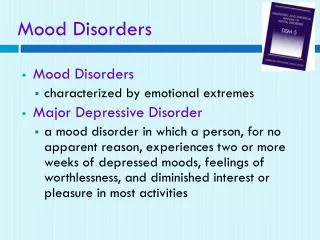
Depression, Con’t • Major Depression • Lasts at least 2 weeks, 75% of waking hours • Typically lasts no more than 6 months • Episodic • Dysthymia • 25% of waking hours • 2 or more years (1 year for adolescents)
Bipolar • Formerly known as Manic Depression • Bipolar 1 and 2 • Mania is required for Bipolar 1 • Mania is a very agitated emotional state with delusions, optimism, energy, impulsive • Tangential thinking, loose associations, derailment. • Technically does not require MDD • Bipolar 2 • Requires MDD • Hypomania • cyclothymia
Suicide • Factors predicting suicide • Feelings of hopelessness • A need to escape • Suicide is an option • Other options are unsatisfactory • The following indicators are increasingly predictive of a suicide attempt: • Thoughts or discussing suicide • People with a plan, • the means to carry out the plan, • Giving away possessions • Past attempts • Recent romantic breakup • substance abuse--alcohol
Schizophrenia • Earliest name: dementia praecox • Symptoms: positive & negative • Positive: hallucinations, delusions, Disordered thought, speech • These symptoms have been added to a person’s repertoire • Negative: Deficit of emotional responses, flat/blunt affect, alogia, anhedonia, asocial, avolition