Transfer Coefficients and Environmental Receptor Dynamics in Pollution Models
This lecture notes document explores the spatial distribution of pollutants in the environment, emphasizing transfer coefficients (aij) and their relevance to environmental receptors. It discusses uniform and non-uniform pollution mixing, pollutant abatement cost functions, and the assessment of marginal damages. Key concepts include the spatial configuration of pollutants, social problems related to environmental damage, and policy implications such as pollutant taxes and ambient standards. The notes provide a framework for understanding pollutant behavior and the economics of environmental policy.

Transfer Coefficients and Environmental Receptor Dynamics in Pollution Models
E N D
Presentation Transcript
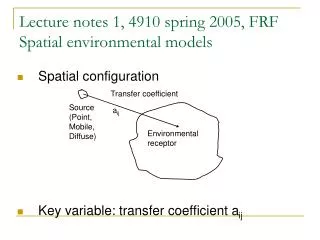
Transfer coefficient Source (Point, Mobile, Diffuse) aij Environmental receptor Lecture notes 1, 4910 spring 2005, FRFSpatial environmental models • Spatial configuration • Key variable: transfer coefficient aij
The Generic model of spatially distributed pollutants • Source abatement cost function • Deposition of pollutants in the environment
Uniformly distributed pollutants • Uniform mix: multiple recipients
Non-uniformly distributed pollutants • Non-uniform mix:
Structured transfer: river pollution • At receptor j: a ranking of transfer coefficients starting upstream at source 1 and ending at nearest source Nj
The spatial social problem • General social problem formulation with damage function
The spatial social problem, cont. • The general first order condition • Non-uniformly mixed: Source marginal abatement cost equal to social marginal damage weighted with transfer coefficients. NB! In general different marginal costs between sources.
Cost effective solutions, cont. • River pollution • Uniformly mixed • Marginal abatement cost equal for all sources and equal to total marginal damage
The pollutant tax solution • Source decision problem • The tax on pollutants is source specific, and should be set equal to the weighted marginal damage in the optimal case. • Uniform distribution: tax rate equal for sources
Ambient standard • Environmental service of receptors • Damage function • The physical ambient standard is the level of deposition of pollutants, dj
Environmental policy in practice • Formulating limits for dj; dj* • Social problem: • The Lagrangian (Economists’ mathematical manual; Kuhn – Tucker, maximisation)
Environmental policy in practice, cont. • First order conditions • Interpretation: Marginal abatement costs equal to shadow prices on ambient constraints weighted with transfer coefficients
Environmental policy in practice, cont. • Interpretation of shadow price • Envelope theorem • Shadow price positive for binding constraints