Exploring the Potential of ARDrone Autonomy with ROS: A Technical Journey
A comprehensive exploration of utilizing Python-based ROS drivers for enhanced control and reduced chaos in programming the ARDrone, detailing challenges and successes encountered by Kim, Lilian, Brad, and Zach during their project. This project showcases the accessibility and advantages of ROS architecture through programmatic control and advanced sensing capabilities for improved drone navigation and perception. Includes insights on SDK integration and testing methodologies for optimal performance.

Exploring the Potential of ARDrone Autonomy with ROS: A Technical Journey
E N D
Presentation Transcript
Accessible Aerial Autonomy HMC Cal Poly Pomona Nick Berezny ‘12, Lilian de Greef ‘12, Brad Jensen ’13, Kim Sheely ‘12, MalenSok’13, and Zach Dodds
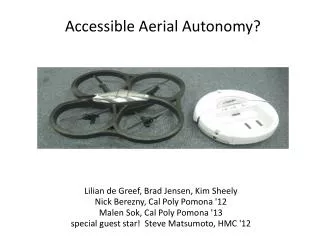
ARDrone as robot? RC toy 802.11b wireless Our video: supermanning it Open, published ASCII protocol Two cameras Gyros and diagnostic sensors
Programmatic control? Publicly available SDK Our video: crash! Would be nice to have Java or Python interfaces… ROS seemed the best path to increased control and decreased chaos
Python-based ROS drivers We found the SDK-based drivers tricky to work with Kim supermanning (2 days) A full SDK-independent Python implementation was available It testifies to ROS’s architecture that it took less than a week to integrate the drone completely, including learning ROS! All four video options are accessible. Psycho helps. images
Control? Perception. Reality.
Vantage advantage GCER 2011 Mutual cooperation between a Create and the ARDrone Sliding-scale autonomy is crucial, at least in development
Sensing! Positives OpenCV + ROS On- and off-board testing Must use vision! In-hand and flight testing Wild motions Negatives Video of the drone and the pink walls Noise … somewhere
Sensing, sensibly! Positives Must use vision! OpenCV + ROS + anything! On- and off-board testing In-hand and flight testing Negatives April Tags Noise … somewhere
Hula Hopping Graph of locations (hula hoops are for us)