Predicting Preeclampsia Using Computational Intelligence: A Neural Network Approach
40 likes | 143 Vues
This study explores a computational intelligent diagnostic system designed to predict preeclampsia in pregnancies at 11-13 weeks. Utilizing artificial neural networks, evolutionary systems, and fuzzy logic, the approach analyzes maternal characteristics alongside obstetric and medical history. Out of 13,538 singleton pregnancies, only 420 developed preeclampsia. The system achieved a classification accuracy of 74.6% with unbalanced data and improved to 90.9% with balanced data. The findings encourage further refinement of the model to enhance predictive accuracy and address misclassification issues.


Predicting Preeclampsia Using Computational Intelligence: A Neural Network Approach
E N D
Presentation Transcript
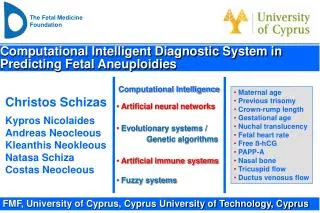
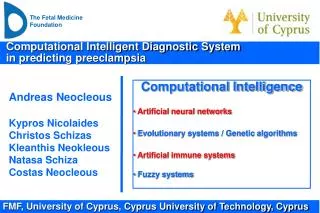
Computational Intelligent Diagnostic System in predicting preeclampsia • Computational Intelligence • Artificial neural networks • Evolutionary systems / Genetic algorithms • Artificial immune systems • Fuzzy systems Andreas Neocleous Kypros Nicolaides Christos Schizas Kleanthis Neokleous Natasa Schiza Costas Neocleous FMF, University of Cyprus, Cyprus University of Technology, Cyprus
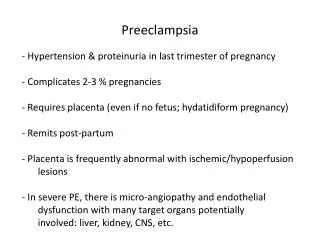
Artificial Neural Network Architecture Input(12 neurons) Maternal characteristics Obstetric & medical history CRL, PAPP-A, Uterine PI, MAP (Linear activation) Hidden Layer 1 (80 neurons) (Logistic-sigmoid activation) Hidden Layer 2 (10 neurons) (Symmetric logistic activation) Hidden Layer 3 (80 neurons) (Logistic-sigmoid activation) Output Layer (1 neurons) Risk of preeclampsia (Logistic-sigmoid activation) Computational Intelligent System in predicting preeclampsia Objective: Use computational intelligence to predict preeclampsia at 11-13 wks All data: Total singleton pregnancies 13,538 No preeclampsia 13,118 (96.9%) Preeclampsia 420 (3.1%) Data for training and validations: Unbalanced data Training various ANNs: 335 PE, 10,496 unaffected by PE Totally unknown cases used for validations: 85 PE, 2,622 unaffected by PE Balanced data Training various ANNs: 335 PE, 352 unaffected by PE Totally unknown cases used for validations: 85 PE, 88 unaffected by PE
Unbalanced data Classification Unaffected Preeclampsia ALL cases 2,622 85 Predicted Correct 1,957 (74.6%) 38 (44.7%) Balanced data Classification Unaffected Preeclampsia ALL cases 88 85 Predicted Correct 80 (90.9%) 80 (94.1%) Computational Intelligent System in predicting preeclampsia Results on the unknown validation (verification) data set:
Computational Intelligent System in predicting preeclampsia Conclusions • Very encouraging findings regarding classification by means of Computational Intelligence • Future work should aim to reduce the normal data in a systematic way so that the new reduced set will reflect the whole database of cases. • Some ‘unaffected’ cases were repeatedly wrongly categorized as ‘PE’ in almost all of the examined networks. When we compared the inputs of these cases with the inputs of some true ‘PE’ cases, we observed that they were quite similar. Thank you