
Novel Approach for Orientational Ordering of Dipolar NLO Chromophores in Optical Devices
This study introduces an innovative method to achieve orientational and positional ordering of dipolar nonlinear optical (NLO) chromophores within a two-dimensional ensemble. Utilizing a robust artificial protein based on a designed amphiphilic 4-helix bundle, we incorporate chromophores featuring a metal-porphyrin unit. This approach addresses the challenge of non-centrosymmetric ordering critical for maximizing the macroscopic NLO response at high chromophore densities. Characterization via synchrotron x-ray scattering and optical second harmonic generation demonstrates the effectiveness of our design, enabling advanced photonic device applications such as frequency doublers and electro-optic modulators.

Novel Approach for Orientational Ordering of Dipolar NLO Chromophores in Optical Devices
E N D
Presentation Transcript
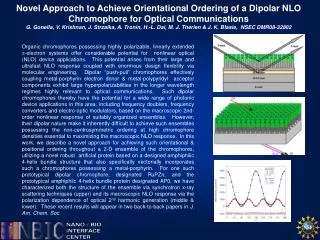
Novel Approach to Achieve Orientational Ordering of a Dipolar NLO Chromophore for Optical Communications G. Gonella, V. Krishnan, J. Strzalka, A. Tronin, H.-L. Dai, M. J. Therien & J. K. Blasie, NSEC DMR08-32802 Organic chromophores possessing highly polarizable, linearly extended-electron systemsoffer considerable potential for nonlinear optical (NLO) device applications. This potential arises from their large and ultrafast NLO response coupled with enormous design flexibility via molecular engineering. Dipolar “push-pull” chromophores effectively coupling metal-porphyrin electron donor & metal-polypyridyl acceptor components exhibit large hyperpolarizabilities in the longer wavelength regimes highly relevant to optical communications. Such dipolar chromophores thereby have the potential for a wide range of photonic device applications in this area, including frequency doublers, frequency converters and electro-optic modulators, based on the macroscopic 2nd-order nonlinear response of suitably organized ensembles. However, their dipolar nature make it inherently difficult to achieve such ensembles possessing the non-centrosymmetric ordering at high chromophore densities essential to maximizing the macroscopic NLO response. In this work, we describe a novel approach for achieving such orientational & positional ordering throughout a 2-D ensemble of the chromophores, utilizing a novel robust artificial protein based on a designed amphiphilic 4-helix bundle structure that also specifically vectorially incorporates such a chromophores possessing a metal-porphyrin. For one such prototypical dipolar chromophore, designated RuPZn, and the prototypical amphiphilc 4-helix bundle protein designated AP0, we have characterized both the structure of the ensemble via synchrotron x-ray scattering techniques (upper) and its macroscopic NLO response via the polarization dependence of optical 2nd harmonic generation (middle & lower). These recent results will appear in two back-to-back papers in J. Am. Chem. Soc.
