Understanding the Nucleon Spin Structure: Insights from Obergurgl 2007 Lecture Series
This lecture from Gerhard Mallot at Obergurgl in October 2007 delves into the experimental status of nucleon spin structure functions, focusing on Q² evolution, scaling violations, and QCD analyses. It also examines the interplay of g1 and g2 functions, semi-inclusive data, and provides insights into the polarised gluon distribution ΔG from hadron pairs. Additionally, it emphasizes the advancements in parton distribution functions (PDFs) and discusses the implications of recent data in understanding nucleon structure and QCD dynamics.

Understanding the Nucleon Spin Structure: Insights from Obergurgl 2007 Lecture Series
E N D
Presentation Transcript
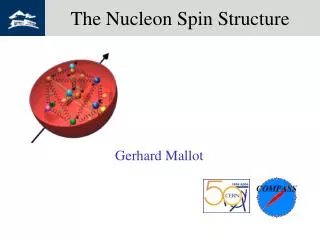
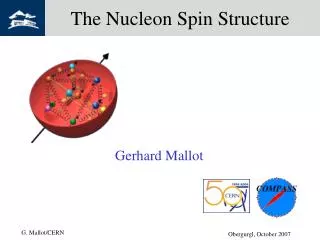
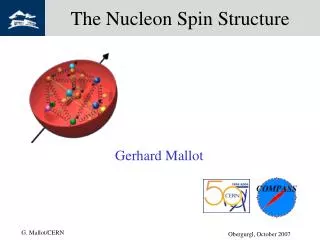
The Nucleon Spin Structure Gerhard Mallot Obergurgl, October 2007
Lecture 2 • Experimental status • Q2 evolution, scaling violations, DGLAP • status of g1 and QCD analyses • interplay: g2 • semi-inclusive data • ΔG from hadron pairs Obergurgl, October 2007
1. Q 2 evolution of structure functions • with increasing Q2 more details are resolved • quarks/gluons split and produce more partons • the ‘new’ partons have smaller x-Bjorken, since the new partons have to share the momentum • scaling violationsin PDFs and SFs: P(x) → P(x,Q2) • the Q 2 evolution is calculable in perturbativeQCD, if the PDFs P(x,Q20) are known at some Q20 • x dependence is non-perturbative and not described in pQCD Obergurgl, October 2007
Parton Distribution Functions Q2= 10 GeV2 Q2= 1000 GeV2 • unpolarised • H1 analysis of HERA ep data • strong increase at small x with Q2 • the various fits agrees very well • fully constrained by data u d g Obergurgl, October 2007
PDFs • Zeus analysis • valence quark distr. • sea quark distr. Obergurgl, October 2007
xg(x,Q2) GRSV std. Q2 = 1000 Q2 = 100 Q2 = 10 Q2 = 1 GeV2 x Polarised gluon evolution Δg (x,Q2) Obergurgl, October 2007
Splitting functions ΔP LO NLO define: Obergurgl, October 2007
Q 2 evolution & DGLAP equations Dokshitzer ‘77; Gribov, Lipatov ‘75; Altarelli, Parisi ‘77 LOcoefficient functions:back to PM expression: Obergurgl, October 2007
Evolution of first moments (LO) Ji Ratcliffe; Ji, Tang, Hoodbhoy; Hägler, Schäfer Obergurgl, October 2007
Q 2 evolution • non-singlet distributions decouple from gluon evolution, moments are Q2-independent , e.g. u − d = ga • evolution of flavour singlet Δqsand gluon are coupled • αs G constant in LO forQ2 → ∞, αs→ 0 therefore scheme ambiguity large (MS ↔ AB) (axial anomaly) • in principle gcan be determined from the Q2evolution of g1(x,Q2) like g in the unpolarised case (DGLAP fit)! • need reasonable range in Q2 at fixed x • we lack a polarisedep collider Obergurgl, October 2007
2. Status of g1 • Wealth of data g1datafor p, n and d • Data taken at different Q2 • Only weak Q2-dependence in overlap region • large x neutron data from JLABfor the neutron (3He): g1n > 0 Obergurgl, October 2007
New g1 data Obergurgl, October 2007
QCD fits to g1(x,Q2) Looks quite nice, but... Obergurgl, October 2007
g1(x,Q2) F2(x,Q2) Obergurgl, October 2007
NLO QCD Fits • choose scheme, usually MS • choose start value for evolution, Q2=Q20 • choose parametrisations for qs,qns, g (x,Q20) • fit parameters of these parametrisations using the DLGAP equations (NLO) • extra problems in polarised case • no positivity condition • no momentum sum rule Obergurgl, October 2007
NLO QCD fits • Many groups, example AAC 2006 AAC: Asymmetry analysis collaboration, Japan GRSV: Glück, Reya, Stratmann, Vogelsang BB: Blümlein, Böttcher LSS: Leader, Sidorov, Stamenov … • Still large uncertaintyin g, even sign not determined Obergurgl, October 2007
AAC06 analysis Obergurgl, October 2007
AAC 2006 Obergurgl, October 2007
First moments • AAC06 [Phys. Rev. D74 (2006) 014015] • GRSV01 [ Phys. Rev. D63 (2001) 094005 ] • LSS01 [ Eur.Phys.J. C23 (2002) 479 ] • BB02 [ Nucl. Phys. B636 (2002) 225 ] only DIS Obergurgl, October 2007
COMPASS QCD fit • parton distributions • New g1d data + world data • G > 0 and G < 0 Q2 = 3 GeV2 Obergurgl, October 2007
COMPASS QCD fit • two solutions:G > 0 and G < 0 • | G|'0.2–0.3 G > 0 G < 0 Obergurgl, October 2007
ΔG = - 0.309 ΔG = 0.336 ΔG as Function ofΔG • Two distinct solutions • ΔG > 0 preferred • ΔG < 0 preferred by small-x points Obergurgl, October 2007
COMPASS QCD fit LSS 2006 COMPASS • Not yet included in fits: final Hermes g1d • Uncertainty due to parametrisation not included ΔG=0.34 ΔG=−0.34 Obergurgl, October 2007
αs from pol. DIS Obergurgl, October 2007
unpolarised: longitudinallypolarised nucleon: β=0,π transversely polarised nucleon: β=±π/2 3. Interplay: g2 Measure asymmetries: Obergurgl, October 2007
Wandzura-Wilczek Twist 3 g2 (quark-gluon corr.) Wandzura-Wilczek : Obergurgl, October 2007
g2 from SLAC Obergurgl, October 2007
Neutrong2 from JLAB maybe first hint of a pure twist-3 effect K. Kramer DIS 2004 Obergurgl, October 2007
4. Semi-inclusive DIS • additional hadron observed in final state Obergurgl, October 2007
dh 1 = 0 d z Fragmentation Function Factorisation! Obergurgl, October 2007
Semi-inclusive DIS final hadron “remembers” flavour of initially struck! poorly known • better: one-particle exclusive Obergurgl, October 2007
Flavour separated polarisation Asymmetries can in LO be related to q by where Obergurgl, October 2007
Alternative: difference asymmetries Valence quark polarisation without fragmentations function Obergurgl, October 2007
Valence quark polarisation Obergurgl, October 2007
5. G from high-pT hadron pairs Obergurgl, October 2007
Photon–gluon fusion (PGF) • Gluon polarisation is measurable in PGF • measure • calculate and • using Monte Carlo Obergurgl, October 2007
Hadron production • LO analysis of hadron-pair asymmetries: • open charm: single D meson AROMA, RAPGAP cleanest process wrt physics background • high-pThadron pairs with Q2 > 1 GeV2 LEPTO • high-pThadron pairs with Q2 < 1 GeV2 PYTHIA • NLO (photo production) • open charm Bojak, Stratmann • single incl. high-pThadronJaeger. Stratmann, Vogelsang • hadron pairs: LO done, Hendlmeier, Stratmann, Schäfer • NLO underway • All analyses up to now in LO (plus parton showers) Obergurgl, October 2007
c c g Open charm at COMPASS • Photon-gluon fusion: 1.2 D0 per PGF cc event BR 4 % or: D0 from D* about 20 % Obergurgl, October 2007
Kπ separation • kaon identification by RICH • cleaner D* → D πs→ K ππsadditional slow pionπs • no D decay vertex due to multiplescattering in solid target • define • sharp peak for D* inΔM Kππs Obergurgl, October 2007
tagging Choose: 3.1 < ΔMKππ < 9.1 MeV Obergurgl, October 2007
Open Charm: D’s from D*’s D* → D πs→ K ππs slow pion required 2002–2004 D0 → K ππ0 D0 → K π Obergurgl, October 2007
Analysing power ALL aLL aLL Obergurgl, October 2007
Open charm: MC • analysis uses event aLLweighting for statistical precision • aLLestimated with NN from event kinematics • indispensable due to large variation of aLL • good correlation of 0.82 between generated and reconstructedaLL aLL generated aLL reconstructed (NN) Obergurgl, October 2007
Light hadron production Resolved photons Ratios for processes for Q2 < 1 Obergurgl, October 2007
Example: kT tuning nucleon photon • systematic error: • determined using 15 independent MC simulations • exploring the parameter space • in kT of nucleon and photon • fragmentation functions • parton shower on/off, • renormalisation scale Obergurgl, October 2007
Resolved photons • More than 50%, however assuming a min and maxscenario, shows little difference. • Probing photon at large x, where photon PDF rather well determined u/u Glück, Reya, Sieg Obergurgl, October 2007
Data versus MC • excellent to good agreement for all kinematics variables pT Obergurgl, October 2007
Gluon polarisation high-pT pairs; Q2>1GeV2 : 2002–2003 high-pT pairs; Q2< 1GeV2 : 2002–2004 Open charm: Obergurgl, October 2007