
Method for Separating Plastic Particles by Density Using Water and Alcohol Solutions
This method outlines procedures to effectively separate a mixture of plastic particles of the same size but differing densities (0.7 g/mL, 0.9 g/mL, and 1.1 g/mL). The process involves first adding water to isolate particles based on density, skimming off the floaters and filtering the sinkers. An alternative method suggests adding alcohol first, followed by water. Investigative questions encourage consideration of how solubility could impact separation methods and the exploration of alternative techniques.

Method for Separating Plastic Particles by Density Using Water and Alcohol Solutions
E N D
Presentation Transcript
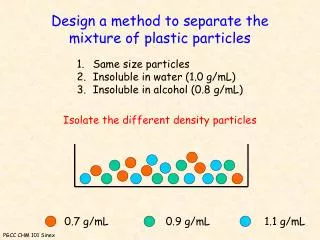
Design a method to separate the mixture of plastic particles • Same size particles • Insoluble in water (1.0 g/mL) • Insoluble in alcohol (0.8 g/mL) Isolate the different density particles 0.7 g/mL 0.9 g/mL 1.1 g/mL PGCC CHM 101 Sinex
To isolated particles- From this mixture- PGCC CHM 101 Sinex
add water 0.7 g/mL 0.9 g/mL 1.1 g/mL PGCC CHM 101 Sinex
skim off floaters water 1.0 g/mL filter sinkers 0.7 g/mL 0.9 g/mL 1.1 g/mL PGCC CHM 101 Sinex
add alcohol 0.7 g/mL 0.9 g/mL 1.1 g/mL PGCC CHM 101 Sinex
skim off floaters alcohol 0.8 g/mL filter sinkers 0.7 g/mL 0.9 g/mL 1.1 g/mL PGCC CHM 101 Sinex
Suppose instead of adding water first as we just did, we added the alcohol to the mixture first. Would this work? PGCC CHM 101 Sinex
Alternative procedure- add alcohol 0.7 g/mL 0.9 g/mL 1.1 g/mL PGCC CHM 101 Sinex
skim off floaters alcohol 0.8 g/mL filter sinkers 0.7 g/mL 0.9 g/mL 1.1 g/mL PGCC CHM 101 Sinex
add water 0.7 g/mL 0.9 g/mL 1.1 g/mL PGCC CHM 101 Sinex
skim off floaters water 1.0 g/mL filter sinkers 0.7 g/mL 0.9 g/mL 1.1 g/mL PGCC CHM 101 Sinex
Follow-up questions to ponder- If these particles were water soluble, would it change your method of separation? If so, explain how. Does this open up the separation to other possible methods? Explain. PGCC CHM 101 Sinex
Does your method have to change if this was the mixture? a written version of the procedure PGCC CHM 101 Sinex