
Understanding Classification and Taxonomy in Science
This overview explains the importance of classification in science, focusing on taxonomy, the scientific study of how living organisms are grouped based on similarities. Learn why students use classification for organization and discovery, such as in binders and stores. Discover binomial nomenclature, developed by Carolus Linnaeus, which provides each organism with a unique two-part name. Explore the eight levels of classification from domain to species, highlighting how this system helps scientists communicate globally, reducing confusion over organism names.

Understanding Classification and Taxonomy in Science
E N D
Presentation Transcript
NIQ #4: Classification Chapter 2 Section 2
Why do scientists classify? • 1. What is classification? • The process of grouping things based on their similarities
2. Why do students use classification? • How is it useful to you as students? • Binders • Lockers • Find things easier in stores • Closest (shoes)
Taxonomy • 3. The scientific study of how living things are classified is called taxonomy.
4. Kaz: What’s it look it? • All fish have: • Fins • Scales • Need water to live • Gills • 2 eyes • 1 mouth
Vocabulary • 1. Classification: The process of grouping things based on their similarities • Example: You can classify animals by where they live.
Vocabulary • 2.Taxonomy: The scientific study of how living things are classified.
Vocabulary • 3.Binomial Nomenclature: The for naming organisms in which each organism is given a unique, two-part scientific name. • Example:Periplanetaamericana • (common cockroach)
The Naming System of Linnaeus • 5. Taxonomy also involves naming organisms. • 6. Carolus Linnaeus: Swedish scientist who devised a naming system. • Linnaeus put organisms in groups based on their observable features.
Classification • How could you classify these things?
Classification • It is always changing because scientists are always coming up with new idea • There are new species and ideas that prove old things inaccurate
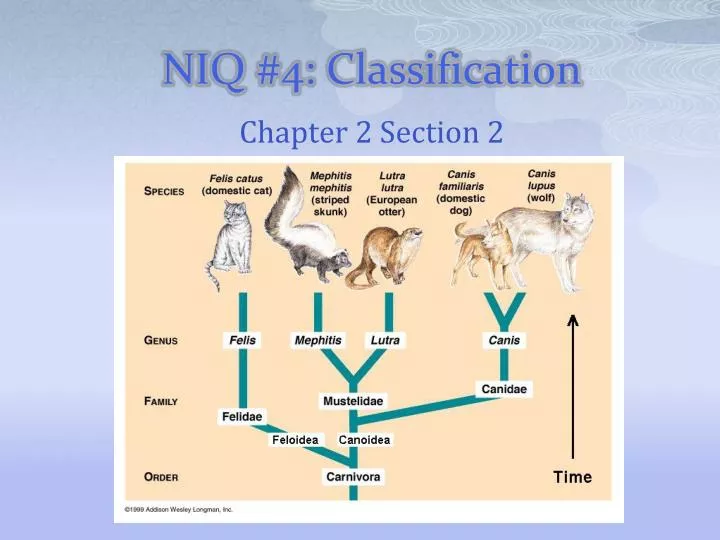
Classification • 8. The naming system is called binomialnomenclature. • 9. The word “binomial” means “twonames”. • Genus • Species
Binomial Nomenclature • Genus: Classification grouping that contains similar, closely related organisms • Example: Felis • Like your last name (general name given to your entire family) • Genus = General!
Binomial Nomenclature • Species: A group of similar organisms that can mate • Example: monax • Like your first name (specific name to you to separate you from the rest of your family) • Species= Specific!
Binomial Nomenclature • 10. BOTH words are in italics and only the first word is capitalized. • Example: Marmotamonax(Groundhog or woodchuck) • Together the two words indicate a unique species!
Binomial Nomenclature • 11. Why is it useful around the world? • So there is so confusion to which organisms that someone is talking about • For example: Here we have groundhogs, but some other places they call them whistlepigs.
Binomial Nomenclature • 12. Why did Linnaeus use Latin? • It was the language that all scientists spoke at that point in time. • It was a common language to scientists.
Levels of Classification • 13. Most classifications today use a series of eight levels to classify organisms. • 14. The classification groups start out general and are then divided into more specific groups. • 15. The more classification levels that two organisms share, the more characteristics they have in common.
Levels of Classification DOMAIN Highest KINGDOM Level PHYLA: (singular is phylum) CLASSES ORDERS FAMILIES GENERA: (singular is genus) Lowest SPECIES Level
Classifying an Owl (p.46) • 17. As you move down the levels (from Domain to Species), there are fewer organisms in each group. • 18. The organisms in the lower groups have more in common.
Vocabulary • 4. Genus: Classification grouping that contains similar, closely related organisms • 5. Species: A group of similar organisms that can mate • 6. Prokaryote: An organism whose cells lack nuclei in them.
Vocabulary • 7. Nucleus: The control center of a eukaryotic cell that directs the cell’s activity and contain the information that determines the cell’s form and function. • 8. Eukaryote: An organism who’s cells contain nuclei. • 9. Competition: The struggle between organisms to survive as they attempt to use the same limited resource.
