CPAP Protocol Reduces Intubation and Mortality in Resource-Limited Settings
10 likes | 151 Vues
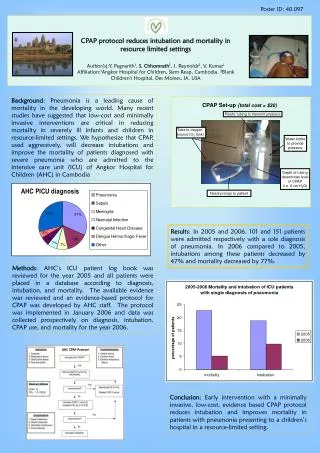
Pneumonia is a leading cause of mortality in the developing world. This study explores the impact of a low-cost, minimally invasive Continuous Positive Airway Pressure (CPAP) protocol implemented at Angkor Hospital for Children, Cambodia. We observed a significant reduction in intubation rates by 47% and mortality by 77% in patients with severe pneumonia after using the CPAP protocol in 2006 compared to 2005. This evidence-based intervention demonstrates that early CPAP application can significantly benefit critically ill infants and children in resource-limited healthcare environments.


CPAP Protocol Reduces Intubation and Mortality in Resource-Limited Settings
E N D
Presentation Transcript
Poster ID: 40.097 CPAP protocol reduces intubation and mortality in resource limited settingsAuthor(s):Y. Pagnarith1, S. Chhomrath1, J. Reynolds2, V. Kumar1Affiliation:1Angkor Hospital for Children, Siem Reap, Cambodia, 2Blank Children's Hospital, Des Moines, IA, USA Background: Pneumonia is a leading cause of mortality in the developing world. Many recent studies have suggested that low-cost and minimally invasive interventions are critical in reducing mortality in severely ill infants and children in resource-limited settings. We hypothesize that CPAP, used aggressively, will decrease intubations and improve the mortality of patients diagnosed with severe pneumonia who are admitted to the intensive care unit (ICU) of Angkor Hospital for Children (AHC) in Cambodia CPAP Set-up (total cost = $30) Plastic tubing to transmit pressure Tube to oxygen source (O2 tank) Water bottle to provide pressure Depth of tubing determines level of CPAP (i.e. 6 cm H2O) Nasal prongs to patient Results: In 2005 and 2006, 101 and 151 patients were admitted respectively with a sole diagnosis of pneumonia. In 2006 compared to 2005, intubations among these patients decreased by 47% and mortality decreased by 77%. Methods: AHC’s ICU patient log book was reviewed for the year 2005 and all patients were placed in a database according to diagnosis, intubation, and mortality. The available evidence was reviewed and an evidence-based protocol for CPAP was developed by AHC staff. The protocol was implemented in January 2006 and data was collected prospectively on diagnosis, intubation, CPAP use, and mortality for the year 2006. AHC CPAP Protocol Conclusion: Early intervention with a minimally invasive, low-cost, evidence based CPAP protocol reduces intubation and improves mortality in patients with pneumonia presenting to a children’s hospital in a resource-limited setting.