
Global Consumption Disparities: Impacts of Rising Economies on Ecological Balance
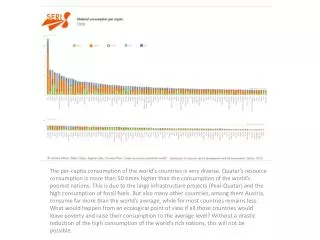
The world's per capita resource consumption varies dramatically, with Qatar consuming over 50 times more than the poorest nations. This imbalance stems from massive infrastructure projects and heavy reliance on fossil fuels. Countries like Austria also exceed average consumption. The ecological consequences of all nations escaping poverty and raising their consumption to average levels could be severe. Without significant reductions in consumption from wealthier countries, sustainable development remains unlikely and ecological stability may be threatened.

Global Consumption Disparities: Impacts of Rising Economies on Ecological Balance
E N D
Presentation Transcript
The per-capita consumption of the world’s countries is very diverse. Quatar’s resource consumption is more than 50 times higher than the consumption of the world’s poorest nations. This is due to the large infrastructure projects (Peal-Quatar) and the high consumption of fossil fuels. But also many other countries, among them Austria, consume far more than the world’s average, while for most countries remains less. What would happen from an ecological point of view if all those countries would leave poverty and raise their consumption to the average level? Without a drastic reduction of the high consumption of the world’s rich nations, this will not be possible.