Understanding Asexual vs. Sexual Reproduction: Key Concepts and Differences
160 likes | 327 Vues
This text explores the fundamental concepts of asexual and sexual reproduction within the context of cell theory. It highlights that all living things are composed of one or more cells and explains that the cell is the smallest unit of life. The document explains how cells reproduce either asexually, with one parent leading to genetically identical offspring, or sexually, involving two parents. Key types of asexual reproduction are described, including binary fission, budding, and regeneration. Additionally, advantages and disadvantages of asexual reproduction are discussed.


Understanding Asexual vs. Sexual Reproduction: Key Concepts and Differences
E N D
Presentation Transcript
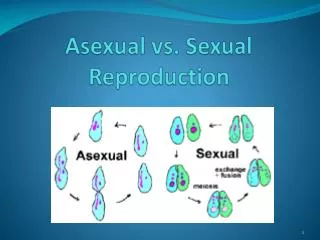
Asexual vs. SexualReproduction Copy words that are red and underlined.
Review: Cell Theory 1. All living things are made of one or more _______. 2. The ______ is the smallest unit of life. 3. All new _____ come from preexisting _____.
In order for #3 to be true, cells must have a way of copying to reproduce other cells. They d_________ themselves to make other cells.
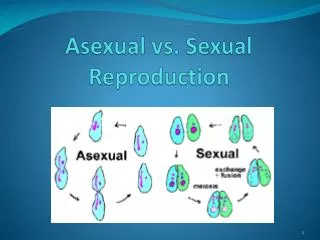
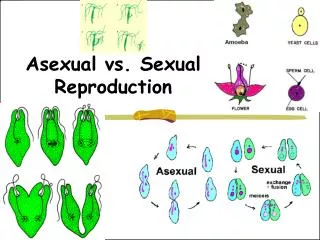
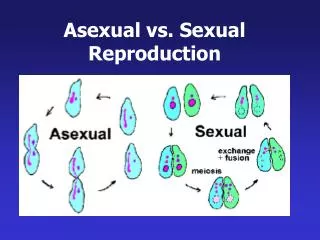
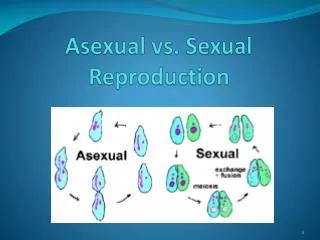
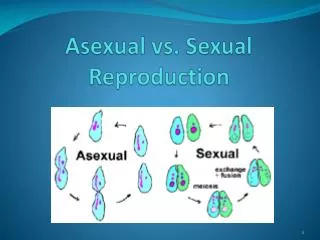
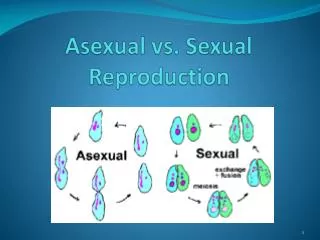
Cells Divide in 2 Ways: • Asexual and SexualReproduction Root words The prefix “a-” means “non-” or “without”. • Sexual means: 1 or 2 parents?
In Sexual Reproduction: • The organism that produces the new organism is called the p____________, and the new organism produced is called the o_________________.
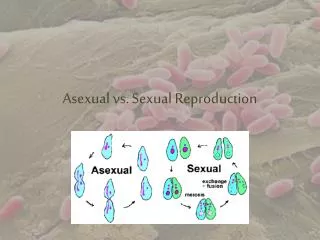
In Asexual Reproduction: • There is only _________ parent so the offspring are genetically (DNA) i__________. DNA
3 Types of Asexual Reproduction • Binary Fission • Budding • Regeneration
Binary Fission • Happens when 1 parent splits into 2. • Use the colors at your table to draw the steps of Binary Fission.
Binary Fission EX: bacteria paramecium amoeba
Budding • A process where an organism develops tiny buds on its body. The buds grow until it forms a complete new organism.
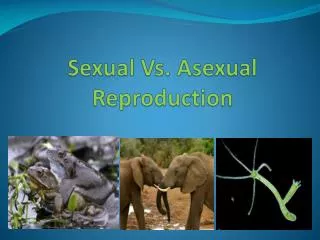
Budding EX: Hydra yeast
Regeneration • Happens in multi-cellular organisms when there is a wound or a lost limb and it re-grows the damaged or missing body part.
Regeneration Use the colors at your table to draw the steps of Regeneration.
Regeneration • EX: Sea Star and Plant Cuttings
Read page 136 in your science book. • What are two advantages of asexual reproduction? • What are two disadvantages of asexual reproduction?