Download
1 / 26
270 likes | 401 Vues
This comprehensive guide covers key concepts in production costs and perfect competition, including total revenue (TR), total cost (TC), and profit/loss calculations. Explore explicit vs. implicit costs, the law of diminishing marginal returns, and the characteristics of perfect competition. You’ll learn to graph total product (TP), marginal product (MP), and average product (AP), alongside fixed and variable costs. Additionally, understand the importance of the shutdown price and the short-run supply curve. Essential for economics students seeking clarity in these fundamental topics.

E N D
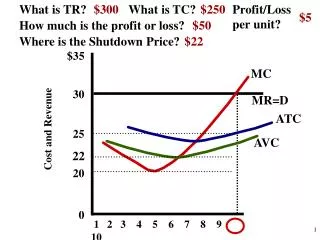
What is TR? $300 What is TC? $250 Profit/Loss per unit? $5 How much is the profit or loss? $50 Where is the Shutdown Price? $22 $35 30 25 20 0 MC MR=D ATC Cost and Revenue AVC 22 1 2 3 4 5 6 7 8 9 10 1
Unit 3: The Costs of Production and Perfect CompetitionREVIEW ACTIVITY 2
Memorizing vs. Learning 123571113171923
Review Circles Odd numbers Even Numbers
3. The Law of Diminishing Marginal Returns and the causes of the 3 Stages
5. Examples of Fixed and Variable Costs and the difference between short-run and long-run. 11
8. Shifting Costs Curves (Changing Variable and Fixed Costs) 14
9. Why is MC “U” Shaped? (Nike swoosh) 15
10. Explain Long-Run and Economies and Diseconomies of Scale 16
11. Graphing Long-Run Average Cost Curves (Economies and Diseconomies of Scale) 17
12. Characteristics of Perfect Competition with examples of each 18
13. Explain Industry, Firm, Price Taker, TR, MR, Economic Profit/Loss, and Profit Max./Loss Min. Rule 19
14. Calculating TR, TC, and profit/loss from a firm graph 20
15. Explain/draw shut down point and how MC above AVC is the short-run supply curve 21
18. Draw firm and industry going from short-run profits to long-run equilibrium 24
19. Draw firm and industry going from short-run losses to long-run equilibrium 25
21. Draw a firm making a $40 profit selling 20 units at a price of $14.
22. Draw a firm making a $60 loss selling 10 units at a price of $35.