Exploring Weak Adsorption of Gases on Complex Surfaces: A Study of Xe on C60 Monolayer
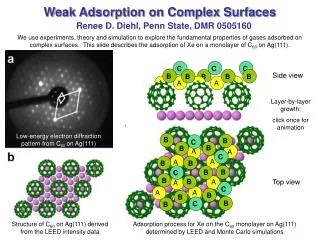
This research investigates the adsorption properties of xenon (Xe) on a monolayer of C60 molecules on an Ag(111) surface, utilizing a blend of experiments, theoretical frameworks, and simulations. The study includes detailed examination through low-energy electron diffraction (LEED) patterns and Monte Carlo simulations to understand the adsorption processes and to visualize layer-by-layer growth of C60 on Ag(111). The project also encompasses innovative educational initiatives aimed at pre-service elementary school teachers, focusing on inquiry-based learning methods in physics.

Exploring Weak Adsorption of Gases on Complex Surfaces: A Study of Xe on C60 Monolayer
E N D
Presentation Transcript
C B B C B B A A C A A A A A A A B B B B C A A B B B B B B B C A A B B C C C B B Weak Adsorption on Complex Surfaces Renee D. Diehl, Penn State, DMR 0505160 We use experiments, theory and simulation to explore the fundamental properties of gases adsorbed on complex surfaces. This slide describes the adsorption of Xe on a monolayer of C60 on Ag(111). Side view Layer-by-layer growth: click once for animation Low-energy electron diffraction pattern from C60 on Ag(111) Top view Structure of C60 on Ag(111) derived from the LEED intensity data Adsorption process for Xe on the C60 monolayer on Ag(111) determined by LEED and Monte Carlo simulations
Weak Adsorption on Complex Surfaces Renee. D. Diehl , Penn State, DMR 0505160 Members of this project are active in the design and implementation of a new physics course for pre-service elementary school teachers. The course is called "Sound and Light" and utilizes an experience-intensive inquiry-based approach. It was developed in collaboration with Annmarie Ward and Carla Zembal-Saul from the College of Education at Penn State University.