American Imperialism
210 likes | 405 Vues
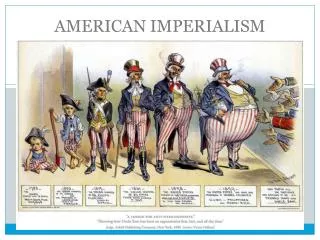
This text explores the roots and implications of American imperialism, highlighting the nation’s foreign policy objectives, particularly in regions like Afghanistan and Iraq, and relationships with allies such as Israel and Saudi Arabia. It defines imperialism and discusses how the U.S. aimed to create global markets, secure naval bases, and maintain power through significant investments and military interventions. Key historical events, including the annexation of Hawaii and the outcomes of the Spanish-American War, frame the ongoing impact of imperial policy on international relations today.


American Imperialism
E N D
Presentation Transcript
Preset: • Define foreign policy. • What is the general purpose of foreign policy for a nation? • Why is the United States currently involved in Afghanistan and Iraq? • Why does the United States maintain good relations with Israel and Saudi Arabia? • Define imperialism. • Is imperialism an example of foreign policy?
Imperialism • Creation of global empires through the establishment of colonies • Africa, SW Asia, South Asia, SE Asia – targeted regions by European powers • Global Empire = sign of Great Power • Created fierce competition among Great Powers to keep and defend and increase size of empire
Why US Imperialism? • Export markets –business interests • Farmers and industries sell surplus goods • Relieve unemployment • Source of raw materials for industry • Alfred T. Mahan – The Influence of Sea Power upon History • US needed strong navy to defend trade lanes • US needed naval bases in Caribbean & Pacific, and a canal to link the Atlantic & Pacific • US needed naval bases to act as coaling stations to project power
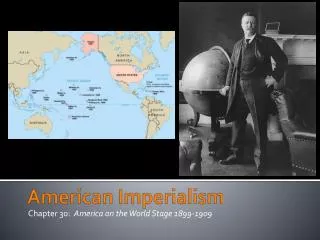
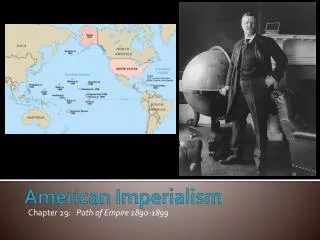
Areas of American Imperialism • Central America • Caribbean • Philippines • Hawaii • China
Hawaii • 1875 – protectorate of US – guaranteed Hawaiian independence, trade rights, Pearl Harbor • Sugar and Pineapple plantations • Sugar growers wanted US to annex to avoid tariffs
US business leaders (Sanford Dole) overthrew Queen Liliuokalani – opposed change to constitution that eliminated property clause for voting • Hawaii annexed in 1898
Spanish-American War (1898) • Cuba, Puerto Rico, Philippines – colonies of Spanish Empire • US – heavy investment in sugar in Cuba • US – wanted stable Cuba to protect investment, Caribbean, canal • US – supported revolutionary movement in Cuba – Jose Marti (Cuban journalist)
“Yellow journalism” – American newspapers wrote stories against Spanish government – concentration camps • USS Maine – US battleship exploded in Havana harbor – Spanish gov. blamed • WAR! • US defeated Spain
Results: • Cuba – protectorate of US – increased US investment • Guantanamo Bay – Caribbean naval base • Puerto Rico – annexed • Guam - annexed • Philippines – annexed for $20 million – became East Asian colony • Philipino insurrection against US led by Emilio Aguinaldo - US put down insurrection
Central America • Panama • US supported rebellion in Columbia for independent Panama (1903) • Why?– canal to link Atlantic and Pacific – trade and navy • Panama – republic – protectorate of US
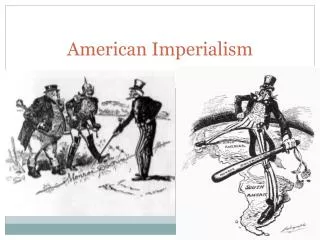
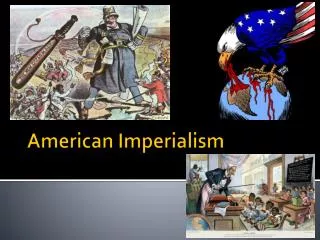
Roosevelt Corollary (1904) • Gave greater strength to the Monroe Doctrine • “Big Stick” Diplomacy • Western Hemisphere = American sphere of influence – off limits to European intervention
Question: Review the naval philosophy of Alfred Mahan. How did the imperialistic actions of the United States reflect the philosophy of Mahan?
China • 1899 – “Open Door Policy” – John Hay (Sec. of State) • China should be open to trade by all countries – no interference in spheres of influence • 1900 – US troops helped put down the “Boxer Rebellion”
1900 – the Boxer Rebellion • Chinese nationalists (“the Boxers”) targeted missionaries and symbols of foreign intervention (RR, businesses) • Resented foreign influence and control of Chinese government • Ching dynasty lost Mandate of Heavan • Multinational force defeated “the Boxers” – protect foreign investment in China
Chinese govt. assessed a fine of 67.5 million pounds to cover damages to foreign investment • China remained under the control of western nations