The Chinese Civil War and the Korean War: A Comprehensive Overview of Cold War Conflicts
This analysis explores the intricate dynamics of the Chinese Civil War (1944-1953) and the Korean War, crucial conflicts during the Cold War era. Led by Mao Zedong, the Communist Party gained momentum with Soviet aid, while Chiang Kai-Shek's Nationalists struggled with corruption despite U.S. support. The Korean War serves as a pivotal moment, with North Korea's invasion of the South and subsequent UN intervention leading to a stalemate. The impact of these wars reshaped U.S. foreign policy and heightened fears of communism, influencing the political landscape of the early 1950s.

The Chinese Civil War and the Korean War: A Comprehensive Overview of Cold War Conflicts
E N D
Presentation Transcript
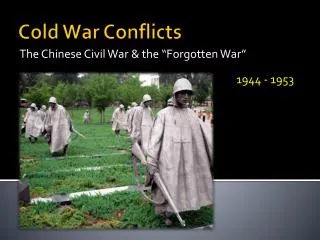
The Chinese Civil War & the “Forgotten War” 1944 - 1953 Cold War Conflicts
Chinese Civil War • Led by Mao Zedong • Relied on aid from the U.S.S.R. • Highly motivated leadership and strong, well-trained guerilla army. • Led by Chiang Kai-Shek • Relied on aid from the U.S. (~$3 billion) • Highly corrupt government • Policies often did not merge with his party beliefs
Chinese Civil War • The United States sends military aid, but does not commit troops. • Despite attempts, we are unable to negotiate peace.
Chinese Civil War Republic of China People’s Republic of China
Chinese Civil War – Major Issues • Containment fails! • “Domino effect”—Once one nation falls, they will all fall. • The U.S. does not recognize the new Communist government in China. • Has the U.S. government been infiltrated?
The Korean War • Korea is split after WWII • Which conference gives Korea independence? • 38th Parallel marks division between North Korea and South Korea • North Korea = Commie • South Korea = Democracy
The Korean War Surprise, surprise – North Korea is occupied by…
The Korean War • North Korea invades South Korea in June 1950.
The Korean War • General Douglas MacArthur counterattacks & forces the North Koreans to the Chinese border.
The Korean War • China joins the fight & forces UN troops back to 38th parallel. • MacArthur pushes Truman to wage full-scale war against China Truman eventually fires MacArthur
Impact: The Forgotten War • The Korean War is a stalemate • Costs $67 billion leads to citizens supporting the Republican candidate in the 1952 election (Dwight D. Eisenhower) • Increased fear of communist aggression • (WE CAN’T EVEN BEAT THEM!)