Download
1 / 9
90 likes | 200 Vues
This document outlines Brazil's ongoing efforts and strategies in human resources development (HRD) within the health sector. Since the 1970s, Brazil has pursued HRD through an inter-ministerial agreement, addressing challenges such as professional management and bridging the gap between academic training and health service needs. Notable achievements include the CADRHU program advancing over 3,000 health professionals and the PROFAE initiative educating 300,000 auxiliary and technical nurses. The document details the Brazilian Network of Observatories and funding commitments aimed at improving health workforce policies and practices.

E N D
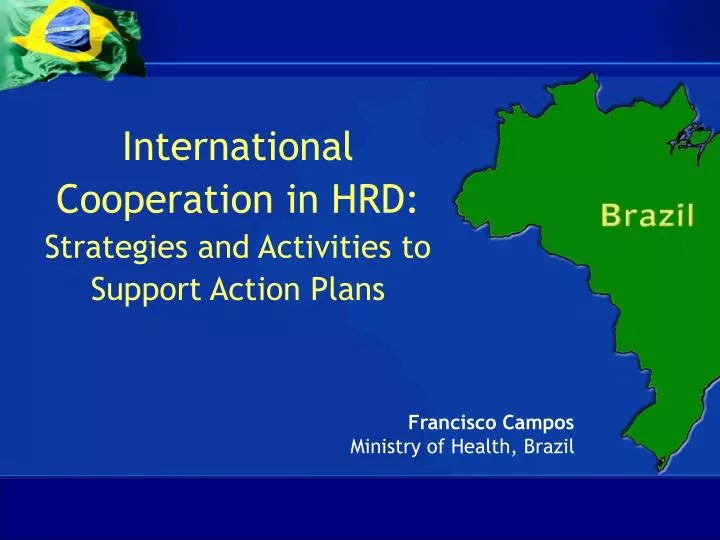
International Cooperation in HRD: Strategies and Activities to Support Action Plans Francisco Campos Ministry of Health, Brazil
Ongoing efforts to tackle HRD in Brazil • > 30 years of pursuing steadily HRD since an Inter ministerial agreement (MOH-E-SS-W) was signed in mid 70s. PAHO (secretariat of this agreement). • Identified problems: Professional management of HR; Lack of Technical Personal (sand clock image) and Gap between academic development and health services needs. • Achievements: • CADRHU (Specialization in HRD commissioned by MOH and developed by a network of academic institutions). Advanced Courses reached >3000 professionals • PROFAE: 300K auxiliary educated and technical nurses in 40 technical schools. • Ongoing efforts to bridge the gap between academia and services.
HRD matters (beyond insiders!) • 26000 HFT covering so far 60% of the Brazilian population (100M people). There is a political decision to increase coverage. • Inappropriate education leads to inadequate practices. • Precarious work leads to high turn-over rates, jeopardizing continuity and professional responsibility.
Brazilian Network of Observatories’ role • Network: 18 nodes, diverse (thematic area, size, institutional links) but all of them closely tied to the mission • Double-Way Partnership: MOH commits 2M US /year to support and counts on them. • Most of the proposed policies are based on evidences generated by the Network of HRH Observatories.
International Expertise - Technical Agreement (TC41) mainstreams: • Is set aside and is an intersection between PAHO’s typical national technical cooperation in HR (MOH funded, 50M$) and international interfaces such as: • Inter sectoral approach to build SUS in Brazil, such as urban and regional development; environmental issues and health; health and diplomatic affairs; and so on • Networking: specialization, management of health systems; technical education and management and research
Case Box: International Course in HRD • Partnership that encompass 21 professionals (health services, academia leaders and profession’s regulators) from 6 countries. MOH provides financial support (300k US). • Target: HRD managers and educators in the Andean Countries and Amazonian Brazilian States. • It has been na outstanding experience in setting cooperation in previous politically tense relationships.
Ministry of Health Secretariat of Management of Education and Work in Health Francisco Campos www.saude.gov.br/sgtes francisco.campos@saude.gov.br