Download
1 / 31
310 likes | 437 Vues
Constraint propagation is a vital reasoning method that improves the decision-making process by analyzing the influence of variable constraints on one another. By determining how constraints affect possible values across variables, techniques such as forward checking and AC3 can minimize the need for extensive decision-making. The efficiency of these methods is crucial in various applications, including map coloring problems and binary constraint management. This dynamic approach helps streamline processes and detect contradictions in complex variable interactions.

E N D
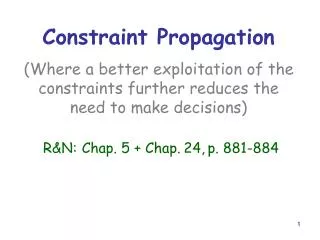
Constraint Propagation(Where a better exploitation of the constraints further reduces the need to make decisions) R&N:Chap. 5 + Chap.24,p. 881-884
Constraint Propagation … … is the process of determining how the constraints and the possible values of one variable affect the possible values of other variables It is an important form of “least-commitment” reasoning
Forward checking is only on simple form of constraint propagation When a pair (Xv) is added to assignment A do: For each variable Y not in A do: For every constraint C relating Y to variables in A do: Remove all values from Y’s domain that do not satisfy C • n = number of variables • d = size of initial domains • s = maximum number of constraints involving a given variable (s n-1) • Forward checking takes O(nsd) time
Forward Checking in Map Coloring Empty set: the current assignment {(WA R), (Q G), (V B)} does not lead to a solution
NT Q WA T NSW SA V Forward Checking in Map Coloring Contradiction that forward checking did not detect
NT Q WA T NSW SA V Forward Checking in Map Coloring Contradiction that forward checking did not detect Detecting this contradiction requires a more powerfulconstraint propagation technique
Constraint Propagation for Binary Constraints REMOVE-VALUES(X,Y) removes every value of Y that is incompatible with the values of X REMOVE-VALUES(X,Y) • removed false • For every value v in the domain of Y do • If there is no value u in the domain of X such that the constraint on (X,Y) is satisfied then • Remove v from Y‘s domain • removed true • Return removed
Constraint Propagation for Binary Constraints AC3 • Initialize queue Qwith all variables (not yet instantiated) • While Q do • X Remove(Q) • For every (not yet instantiated) variable Y related to X by a (binary) constraint do • If REMOVE-VALUES(X,Y) then • If Y’s domain = then exit • Insert(Y,Q)
Complexity Analysis of AC3 • n = number of variables • d = size of initial domains • s = maximum number of constraints involving a given variable (s n-1) • Each variable is inserted in Q up to d times • REMOVE-VALUES takes O(d2) time • AC3 takes O(ndsd2) = O(nsd3) time • Usually more expensive than forward checking • AC3 • Initialize queue Qwith all variables (not yet instantiated) • While Q do • X Remove(Q) • For every (not yet instantiated) variable Y related to X by a (binary) constraint do • If REMOVE-VALUES(X,Y) then • If Y’s domain = then exit • Insert(Y,Q)
XY {1, 2} {1, 2} X Y YZ XZ Z {1, 2} Is AC3 all that we need? • No !! • AC3 can’t detect all contradictions among binary constraints
XY {1, 2} {1, 2} X Y YZ XZ Z {1, 2} Is AC3 all that we need? • No !! • AC3 can’t detect all contradictions among binary constraints REMOVE-VALUES(X,Y) • removed false • For every value v in the domain of Y do • If there is no value u in the domain of X such that the constraint on (X,Y) is satisfied then • Remove v from Y‘s domain • removed true • Return removed
XY {1, 2} {1, 2} X Y YZ XZ Z {1, 2} Is AC3 all that we need? • No !! • AC3 can’t detect all contradictions among binary constraints REMOVE-VALUES(X,Y,Z) • removed false • For every value w in the domain of Z do • If there is no pair (u,v) of values in the domains of X and Y verifying the constraint on (X,Y) such that the constraints on (X,Z) and (Y,Z) are satisfied then • Remove w from Z‘s domain • removed true • Return removed REMOVE-VALUES(X,Y) • removed false • For every value v in the domain of Y do • If there is no value u in the domain of X such that the constraint on (X,Y) is satisfied then • Remove v from Y‘s domain • removed true • Return removed
XY {1, 2} {1, 2} X Y YZ XZ Z {1, 2} Is AC3 all that we need? • No !! • AC3 can’t detect all contradictions among binary constraints • Not all constraints are binary
Tradeoff Generalizing the constraint propagation algorithm increases its time complexity • Tradeoff between time spent in backtracking search and time spent in constraint propagation A good tradeoff when all or most constraints are binary is often to combine backtracking with forward checking and/or AC3 (with REMOVE-VALUES for two variables)
Modified Backtracking Algorithm with AC3 • CSP-BACKTRACKING(A, var-domains) • If assignment A is complete then return A • Run AC3 and update var-domains accordingly • If a variable has an empty domain then return failure • X select a variable not in A • D select an ordering on the domain of X • For each value v in D do • Add (Xv) to A • var-domains forward checking(var-domains, X, v, A) • If no variable has an empty domain then(i) result CSP-BACKTRACKING(A, var-domains)(ii) If result failure then return result • Remove (Xv) from A • Return failure
X1 {1,2,3,4} X2 {1,2,3,4} 1 2 3 4 1 2 3 4 X3 {1,2,3,4} X4 {1,2,3,4} A Complete Example:4-Queens Problem 1) The modified backtracking algorithm starts by calling AC3, which removes no value
X1 {1,2,3,4} X2 {1,2,3,4} 1 2 3 4 1 2 3 4 X3 {1,2,3,4} X4 {1,2,3,4} 4-Queens Problem 2) The backtracking algorithm then selects a variable and a value for this variable. No heuristic helps in this selection. X1 and the value 1 are arbitrarily selected
X1 {1,2,3,4} X2 {1,2,3,4} 1 2 3 4 1 2 3 4 X3 {1,2,3,4} X4 {1,2,3,4} 4-Queens Problem 3) The algorithm performs forward checking, which eliminates 2 values in each other variable’s domain
X1 {1,2,3,4} X2 {1,2,3,4} 1 2 3 4 1 2 3 4 X3 {1,2,3,4} X4 {1,2,3,4} 4-Queens Problem 4) The algorithm calls AC3
X1 {1,2,3,4} X2 {1,2,3,4} 1 2 3 4 1 2 3 4 X3 {1,2,3,4} X4 {1,2,3,4} 4-Queens Problem X2 = 3 is incompatible with any of the remaining valuesof X3 4) The algorithm calls AC3, which eliminates 3 from the domain of X2
X1 {1,2,3,4} X2 {1,2,3,4} 1 2 3 4 1 2 3 4 X3 {1,2,3,4} X4 {1,2,3,4} 4-Queens Problem 4) The algorithm calls AC3, which eliminates 3 from the domain of X2, and 2 from the domain of X3
X1 {1,2,3,4} X2 {1,2,3,4} 1 2 3 4 1 2 3 4 X3 {1,2,3,4} X4 {1,2,3,4} 4-Queens Problem • The algorithm calls AC3, which eliminates 3 from the domain of X2, and 2 from the domain of X3, and 4 from the domain of X3
X1 {1,2,3,4} X2 {1,2,3,4} 1 2 3 4 1 2 3 4 X3 {1,2,3,4} X4 {1,2,3,4} 4-Queens Problem • The domain of X3 is empty backtracking
X1 {1,2,3,4} X2 {1,2,3,4} 1 2 3 4 1 2 3 4 X3 {1,2,3,4} X4 {1,2,3,4} 4-Queens Problem • The algorithm removes 1 from X1’s domain and assign 2 to X1
X1 {1,2,3,4} X2 {1,2,3,4} 1 2 3 4 1 2 3 4 X3 {1,2,3,4} X4 {1,2,3,4} 4-Queens Problem • The algorithm performs forward checking
X1 {1,2,3,4} X2 {1,2,3,4} 1 2 3 4 1 2 3 4 X3 {1,2,3,4} X4 {1,2,3,4} 4-Queens Problem • The algorithm calls AC3
X1 {1,2,3,4} X2 {1,2,3,4} 1 2 3 4 1 2 3 4 X3 {1,2,3,4} X4 {1,2,3,4} 4-Queens Problem • The algorithm calls AC3, which reduces the domains of X3 and X4 to a single value
NT Q WA NSW SA T V Exploiting the Structure of CSP If the constraint graph contains several components, then solve one independent CSP per component
X Y Z V U W Exploiting the Structure of CSP If the constraint graph is a tree, then : Order the variables from the root to the leaves (X1, X2, …, Xn) For j = n, n-1, …, 2 callREMOVE-VALUES(Xj, Xi) where Xi is the parent of Xj Assign any valid value to X1 For j = 2, …, n do Assign any value to Xj consistent with the value assigned to its parent Xi (X, Y, Z, U, V, W)
NT Q WA NSW SA V Exploiting the Structure of CSP Whenever a variable is assigned a value by the backtracking algorithm, propagate this value and remove the variable from the constraint graph
NT Q WA NSW V Exploiting the Structure of CSP Whenever a variable is assigned a value by the backtracking algorithm, propagate this value and remove the variable from the constraint graph If the graph becomes a tree, then proceed as shown in previous slide


![G3 - RADIO WAVE PROPAGATION [3 Exam Questions -- 3 Groups]](https://cdn0.slideserve.com/819386/g3-radio-wave-propagation-3-exam-questions-3-groups-dt.jpg)