
Absence of Silver-Positive Neurofibrillary Tangles in Aged E391 Transgenic Mice
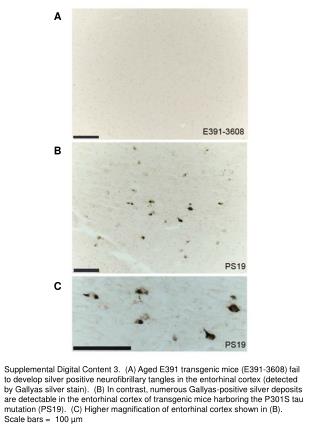
This study examines the entorhinal cortex of aged E391 transgenic mice, which fail to exhibit silver-positive neurofibrillary tangles as identified by Gallyas silver staining. In stark contrast, numerous Gallyas-positive silver deposits are found in the same region of transgenic mice with the P301S tau mutation (PS19). The findings highlight differences in neurodegenerative pathology between these models, emphasizing the significance of tau mutations in the development of neurofibrillary tangles. Higher magnification images reveal the qualitative differences in tau-related deposition in the entorhinal cortex.

Absence of Silver-Positive Neurofibrillary Tangles in Aged E391 Transgenic Mice
E N D
Presentation Transcript
A B C Supplemental Digital Content 3. (A) Aged E391 transgenic mice (E391-3608) fail to develop silver positive neurofibrillary tangles in the entorhinal cortex (detected by Gallyas silver stain). (B) In contrast, numerous Gallyas-positive silver deposits are detectable in the entorhinal cortex of transgenic mice harboring the P301S tau mutation (PS19). (C) Higher magnification of entorhinal cortex shown in (B). Scale bars = 100 µm