
Correlation Between Upper-Limb Activity and Sedentary Behavior in Adults
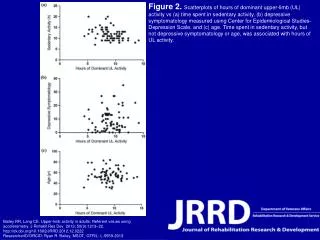
This study examines the relationship between hours of dominant upper-limb activity and various factors: (a) time spent in sedentary activity, (b) depressive symptomatology as measured by the Center for Epidemiological Studies-Depression Scale, and (c) age. Findings indicate that increased time in sedentary behavior is significantly associated with hours of upper-limb activity, while no significant associations were found for depressive symptoms or age. These insights may help inform interventions aimed at promoting physical activity among adults.

Correlation Between Upper-Limb Activity and Sedentary Behavior in Adults
E N D
Presentation Transcript
Figure 2. Scatterplots of hours of dominant upper-limb (UL) activity vs (a) time spent in sedentary activity, (b) depressive symptomatology measured using Center for Epidemiological Studies-Depression Scale, and (c) age. Time spent in sedentary activity, but not depressive symptomatology or age, was associated with hours of UL activity. Bailey RR, Lang CE. Upper-limb activity in adults: Referent values using accelerometry. J Rehabil Res Dev. 2013; 50(9):1213–22. http://dx.doi.org/10.1682/JRRD.2012.12.0222 ResearcherID/ORCID: Ryan R. Bailey, MSOT, OTR/L: L-5559-2013
