Download
1 / 53
530 likes | 634 Vues
Dive into a challenging Jeopardy-style review game focused on chemical bonding, nomenclature, and vocabulary in chemistry. This activity covers essential concepts, including types of chemical bonds, molecular formulas, and the rules governing ionic and covalent interactions. Players will answer questions across various categories with increasing difficulty, enhancing their understanding of bonding and chemical formulas. Ideal for students preparing for exams or anyone looking to refresh their chemistry knowledge!

E N D
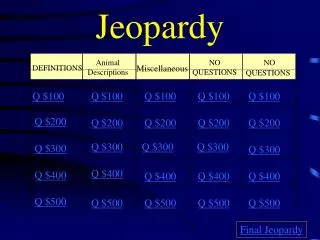
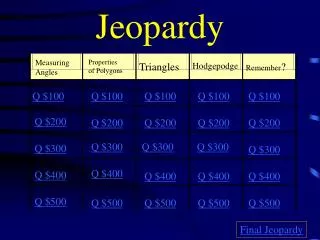
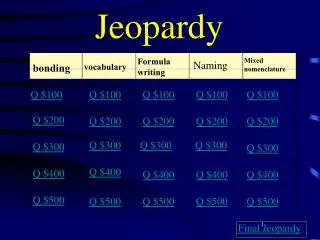
Jeopardy Formula writing Mixed nomenclature Naming bonding vocabulary Q $100 Q $100 Q $100 Q $100 Q $100 Q $200 Q $200 Q $200 Q $200 Q $200 Q $300 Q $300 Q $300 Q $300 Q $300 Q $400 Q $400 Q $400 Q $400 Q $400 Q $500 Q $500 Q $500 Q $500 Q $500 1 Final Jeopardy
$100 Question from bonding What is the mutual attraction of the nuclei of two different atoms for the same electrons called? 2
$100 Answer from bonding Chemical bond 3
$200 Question from bonding What type of bond occurs between metals & non-metals resulting in a “transfer” of electrons? 4
$200 Answer from bonding Ionic bond 5
$300 Question from bonding What type of bond occurs when atoms share electrons? 6
$300 Answer from bonding Covalent bond 7
$400 Question from bonding What type of bond is found in molecules? 8
$400 Answer from bonding Covalent bond 9
$500 Question from bonding What type of bond is found in the compound, MgO? 10
$500 Answer from bonding Ionic bond 11
$100 Question from vocabulary The forces that hold different atoms or ions together are _____bonds. 12
$100 Answer from vocabulary Chemical bonds 13
$200 Question from vocabulary An ionic bond is a bond that forms between ions with ____ charges 14
$200 Answer from vocabulary opposite 15
$300 Question from vocabulary How many electrons are needed in the outermost energy level to make an atom chemically stable? 16
$400 Question from vocabulary Non-metals are located on which side of the periodic table? 18
$400 Answer from vocabulary Right side 19
$500 Question from vocabulary What is the rule that indicates the atom’s desire to have 8 valence electrons called? 20
$500 Answer from vocabulary Octet rule 21
$100 Question from formula writing Sodium Chloride 22
$100 Answer from formula writing NaCl 23
$200 Question from formula writing Lithium carbonate 24
$200 Answer from formula writing Li2CO3 25
$300 Question from formula writing Silicon tetrachloride 26
$300 Answer from formula writing SiCl4 27
$400 Question from formula writing Copper I Sulfate 28
$400 Answer from formula writing Cu2(SO4) 29
$500 Question from formula writing Lead IV Phosphate 30
$500 Answer from formula writing Pb3(PO4)4 31
$100 Question from naming CaCl2 32
$100 Answer from naming Calcium Chloride 33
$200 Question from naming (NH4)(C2H3O2) 34
$200 Answer from naming Ammonium acetate 35
$300 Question from naming SnO 36
$300 Answer from naming Tin II Oxide 37
$400 Question from naming N2O5 38
$400 Answer from naming Dinitrogen Pentoxide 39
$500 Question from naming Fe(CO3) 40
$500 Answer from naming Iron II Carbonate 41
$100 Answer from mixed nomenclature Iron II Sulfide 43
$200 Question from mixed nomenclature Oxygen difluoride 44
$300 Answer from mixed nomenclature Tin IV Oxide 47
$400 Answer from mixed nomenclature Potassium Nitrate 49
$500 Question from mixed nomenclature What is the general formula for the reaction between an Alkali metal (X) and a Halogen (Y)? 50