Ancient China
Explore the geographical influences on Ancient China, the dynastic cycle, philosophies like Confucianism and Daoism, daily life, and the rise and fall of various Chinese dynasties. Learn about key historical events, the Great Wall, and the significance of the Silk Road in shaping China's rich history. Prepare for your upcoming unit exam with essential study tips and review materials.
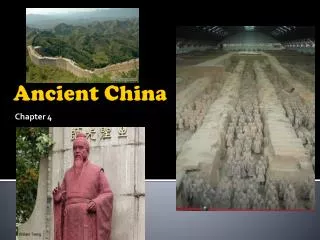

Ancient China
E N D
Presentation Transcript
Chapter 4 Ancient China
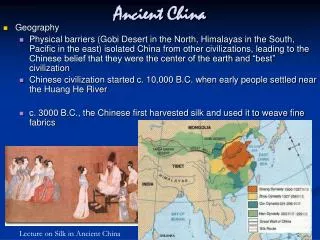
Geographical Influences • Mountains, sea, and desert provide some protection and isolation • Vulnerable to northwest • River valleys • Yellow (Huang He)- earliest civilization - damaging floods • Yangtze - very important in unification- transportation- irrigation
Outside China during Shang period (1750BC – 1000BC) • Hammurabi’s code • Mycenaean Civilization In Greece • Vedic period in India • Stonehenge in England • Moses led Israelites out of Egypt • Mayans processed rubber • King Tut • Homer’s Troy fell • Ramses II of Egypt
Earliest Civilizations - most isolated • Earliest group – (Neolithic) Ban Po- similar to other parts of the world/ one of the oldest civilizations • Shang Dynasty 1750-1000 BC (FIRST DYNASTY) in N. China along the Huang He - raised silk worms - silk part fascination of China, famous for bronze sculpture, daggers, jade jewelry paid homage to ancestors- family important • Zhou Dynasty 1000-256 BC – longest dynasty – developed foundations for Chinese society
Dynastic Cycle & Mandate of Heaven • Mandate of Heaven • Divine (heavenly) approval giving the right to rule to the emperor
Zhou Dynasty • Wu Wang – first king of Zhou, gave land grants to lords, relatives, & general • Farming was profitable • Blast furnace used to create iron • Education spread from upper classes to others • Book of Songs – 305 poems • 707-480 BC – lords became too powerful • Civil War followed, ending the Zhou Dynasty
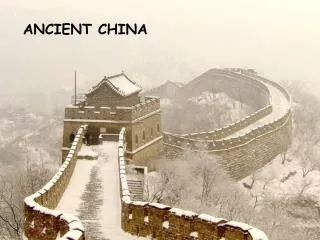
Qin Dynasty • Qin Shin Huangdi– founded dynasty 221BC • authoritarian ruler: • ordered nobles to capital • everyone paid high taxes • strict laws & harsh punishments • burned books • created unity with coins, weights & measures, and roads & canals • Ordered sections of wall to be joined to form a “Great Wall” • Son overthrown – end of dynasty
Han Dynasty • Liu Bang – founded dynasty 202BC • Wudi– greatest leader • built Silk Road for trade with the West • established school for civil servants – need for civil service examination rather than favoritism • improved silk factories; invented paper, stirrups, wheelbarrow; plow with moveable parts • expanded territory from Korea to Vietnam • AD220 – warlords attacked & overthrew emperor
Ancient Philosophies • religions in Ancient China • Confucianism– 5 Relationships • Daoism– Yin & Yang, balance • Buddhism(from India) • showed concerned with ethical life on earth • Filial Piety – obedience and respect for one’s parents • Legalism– strong law and harsh punishment to maintain order, created by Xunzi
Confucianism • Moral and ethical code highly developed to treat everyone with consideration • Value on family head- ancestor respect • Valued loyalty, righteousness, wisdom, sincerity • Five Relationships: one is an example to the other, inferior learns from superior • Ruler - subjects • Father – son • Husband – wife • Older Brother – younger brother • Friend – friend (members of a community)
Daoism (Taoism) and the Laosi • contemporary of Confucius • Dao/Tao= the way • the Dao is absolute = sum of existence • goal: to bring people into harmony • very introspective • not as influential as Confucius, but still popular
Life and Culture • Sons more important than daughters • Ban Zhao – wrote guide for young women, Admonitions for Girls • agrarian economy – based on farming • excellent scholars and mathematicians • calculated when eclipse would occur • books written on Algebra & Geometry • pi(p) calculated to 6 decimal places (3.141592) • physiciansneeded to pass an examination to practice – patients treated with acupuncture • educationand literacy was mostly for upper class – most important during Zhou dynasty
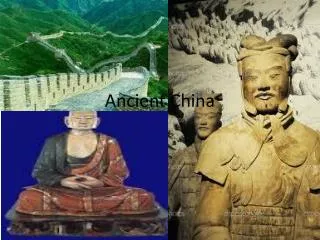
Terra Cotta Army: First Emperor’s Tomb Chinese Cooking Vessel
Bell Ringer:As you sit down and get ready for the day, think about this and create a quick chart in your notes…
Unit Exam Next WeekTuesday (1, 3) or Wednesday (5, 6) • Look over the review half sheet • Items at the top are where the questions come from – NOT useable for notes! • FIB Outlines, charts, and handwritten notebook notes ARE acceptable notes! • You only need to know what is on the sheet – noticed they are grouped by topic/chapter • IF SOMETHING IS NOT ON THE HALF SHEET IT IS NOT ON THE UNIT EXAM! • MULTIPLE CHOICE – we will be using the qwizdom remotes, no pencil needed