Addressing Gender Disparities in Faculty Roles and Compensation in COSE: An NSF ADVANCE Grant Initiative
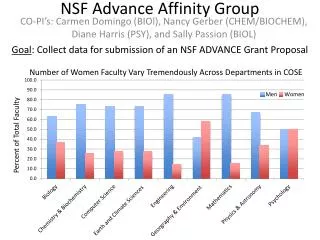
This project aims to collect data for an NSF ADVANCE Grant proposal focused on the disparities faced by women faculty in the College of Sciences and Engineering (COSE). It highlights significant variations in the number of women faculty across departments and identifies key issues, including lower earnings, committee workload, and mentorship challenges. The findings from focus groups with assistant and associate professors reveal systemic barriers and inequities that hinder women's professional advancement and satisfaction in academia. Our goal is to propose actionable solutions for creating a more equitable academic environment.

Addressing Gender Disparities in Faculty Roles and Compensation in COSE: An NSF ADVANCE Grant Initiative
E N D
Presentation Transcript
Goal: Collect data for submission of an NSF ADVANCE Grant Proposal Number of Women Faculty Vary Tremendously Across Departments in COSE NSF Advance Affinity Group Percent of Total Faculty CO-PI’s: Carmen Domingo (BIOl), Nancy Gerber (CHEM/BIOCHEM), Diane Harris (PSY), and Sally Passion (BIOL)
Women Spend More Time at the Associate Level Women faculty in COSE earn approximately $400 less per month than men faculty 26 13 5 6 6 Men (n=32) Women (n=18) Sample size = 152 P value=0.0305 26
Results of Focus Group: Assistant Professors • Female faculty bear disproportionately more time on advising. • RTP criteria is too broad. • Difficult to find mentors within their department. • Inflexible working hours, expensive day care, and less family time leads many to worry about their ability to remain in academia. • Monetary compensation is inadequate given the workload. Associate Professors • Promotion to full is focused on research productivity. • Criteria for promotion to Professor is unclear. • Teaching receives less recognition or rewarded. • Female faculty bear disproportionately higher share of committee work with no compensation or reward mechanism. • Difficult to find senior women mentors within their department. • Concerned about salary inequities. • Women and women of color carry extra burden of student advising.