Download
1 / 2
20 likes | 137 Vues
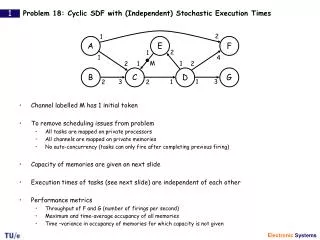
This document outlines a problem involving a Cyclic Synchronous Dataflow (SDF) model with independent stochastic execution times. The model has a single initial token for the channel labeled 'M' and focuses on resolving scheduling issues. All tasks are assigned to private processors, while channels are connected to private memories. The system emphasizes sequential task execution, devoid of auto-concurrency, with execution times varying independently. Key performance metrics explored include throughput for tasks F and G, maximum and time-average memory occupancy, and occupancy variance.

E N D
A F 2 1 E 2 1 1 4 M G B C D 1 2 1 2 3 1 3 1 2 2 Problem 18: Cyclic SDF with (Independent) Stochastic Execution Times • Channel labelled M has 1 initial token • To remove scheduling issues from problem • All tasks are mapped on private processors • All channels are mapped on private memories • No auto-concurrency (tasks can only fire after completing previous firing) • Capacity of memories are given on next slide • Execution times of tasks (see next slide) are independent of each other • Performance metrics • Throughput of F and G (number of firings per second) • Maximum and time-average occupancy of all memories • Time –variance in occupancy of memories for which capacity is not given
Execution Times and Memory Capacities Capacity of all other memories is part of the problem