Download

1 / 17
190 likes | 330 Vues
This guide outlines the rules for determining the divisibility of numbers by 2, 3, 4, 5, 6, 7, 8, 9, and 10, providing practical examples for clarity. It also highlights the contributions of the Greek mathematician Eratosthenes, known for his work in prime number identification and the measurement of the Earth's circumference, and the German mathematician Carl Friedrich Gauss, whose contributions to mathematics and physics are significant. Learn how these principles and figures have shaped mathematical understanding.

E N D
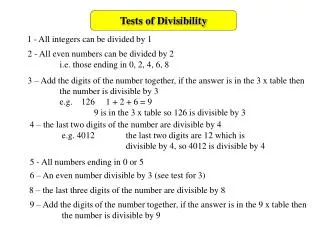
a number is divisible by: 2 – if the number is even or the numeral in the ones’ place is either 0,2,4,6,8 Example: 202, 308, 1090
3– if the sum of the digits is a multiple of 3 Example: 4569 (4 + 5 + 6+ 9= 24 )
4– if the number formed by the last two numerals on the right is a multipe of 4 Example: 1312 (12/4 = 3 )
5– if the numeral in the ones’ place is 0 or 5 Example: 1000, 3685, 105
6– if then number is even and is also divisible by 3 Example: 114 (1 + 1 + 4 =6) Even
7– If you double the last digit and subtract it from the rest of the number and the answer is: 0, or divisible by 7 Example: 672 (Double 2 is 4, 67-4=63, and 63÷7=9)
8– if the number formed by the last three numerals on the right is a multiple of 8 Example: 109816
9– if the sum of the digits is a multiple of 9 Example: 1629 ( 1+6+2+9=18) (1+8=9)
10 – if the numeral on the ones place is 0 Example: 100, 50, 18390
The Sieve of Eratosthenes
200 B.C. – discovered a pattern of dividing the set of counting numbers except 1 into prime and composite
Eratosthenes (276-196 B.C.) • Greek mathematician, astronomer, geographer • Measured the circumference of the Earth with extraordinary accuracy • Born in Cyrene (Shahhat, Libya) • Greek poet teacher- Callimachus • 240 B.C.- became the head of the library in Alexandria • Calculate by Trigonometry both the distance to the sun and the circumference of the Earth • Most important work was a systematic treatise on geography
Complete Factorization
Carl Friedrich Gauss (1777-1855) • German mathematician • Wide ranging contributions to Physics- the study of electromagnetism • Born in Braunschweig (April 30, 1777) • Studied ancient language but became interested in Mathematics (17 yrs. Old) • The Fundamental Theorem of Algebra