Evolution of Telecommunication: From Early Messaging to Modern Signal Transmission
This piece explores the transformative journey of telecommunication from its inception in passing messages over distances to the advanced technologies we utilize today. Key developments, including the introduction of the telephone and subsequent innovations, are examined. The physics behind wave transmission—both longitudinal and transverse—along with the essential concepts of wave interference, reflection, and refraction are covered. This exploration also highlights the transition from analogue to digital signals, the role of satellites, and the need for masts to boost signals due to attenuation over distances.

Evolution of Telecommunication: From Early Messaging to Modern Signal Transmission
E N D
Presentation Transcript
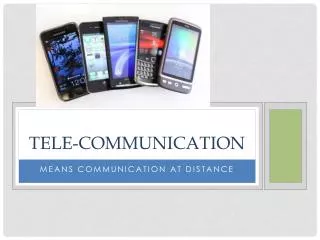
Tele-communication Meanscommunication at distance
Waves Longitudinal: sound Transverse: emspectrum
Attenuation • Over a distancetheenergy in a signalisdissipated as it spreads out so thesignal at anyonepointgetsweaker. • Thisiswhyweneedphone, tv and radio masts to boostthesignals. • Imagine as youmoveawayfrom a light source in thenight – itseffectgetsless. Itisjustthesamewithradiowaves and microwaves.
A bit of physics • V = λx f • Where v = velocity • λ = wavelength • f = frequency • In the case of emspectrum v iscalled c as in Einstein´sfamousequation • E = mc² • C = 3 x 10⁸ m/s • Rearrangetheequation to findthefrequency of 15 cm microwaves.
Practicaldifference Analogue Digital
Benefits and disadvantages of analogue Benefit Disadvantage Loosesinformation • Allowsmuchgreaterinfo. storage • Easier to reproduce • Easier to send and transport
e.g. film • A movingpictureismade up of 24 stillframes a second • Oureyes use thisdiscreteinformation and ourbrainperceivesit as ifwewerelooking at movement in normal life. • Conversely digital allowsusnow to projectmany more frames per secondgivingmuchgreaterresolutione.gphantom cameras.