How Boring Bars Contribute To Micro-Machining And Ultra-Precision Engineering
0 likes | 6 Vues
Explore how boring bars contribute to micro-machining and ultra-precision engineering. Learn how leading precision boring bars manufacturers in Bangalore deliver accuracy and stability for intricate component fabrication.


How Boring Bars Contribute To Micro-Machining And Ultra-Precision Engineering
E N D
Presentation Transcript
How Boring Bars Contribute To Micro- Machining And Ultra-Precision Engineering In the field of manufacturing, where millimetres were once the standard, microns have now taken precedence. Micro-machining and ultra-precision engineering are paving the way for advancements in aerospace, medical devices, semiconductors, and optics. Central to this evolution is an unexpectedly familiar tool – the boring bar. Traditionally viewed as a tool for enlarging holes in metal, boring bars are now being innovated and enhanced to function at scales once thought to be impossible. Understanding the micro-machining and ultra-precision landscape Micro-machining involves the creation of extremely small components or complex features with tolerances as tight as ±1 micron or even better. Items such as miniature gears, micro- valves, and sensor housings necessitate internal designs that are not only minuscule, but also geometrically flawless and burr-free. On the other hand, ultra-precision engineering focuses on applications that require accuracy at the nanometre level. Whether for satellites or surgical implants, it demands both dimensional precision and impeccable surface finishes. The risks are significant – even a deviation of 10 microns can lead to failure. How boring bars serve the industry Boring bars play an essential role in shaping internal geometries that other tools cannot access. In micro and ultra-precision applications, boring bars facilitate burr-free edge finishing, perfect roundness and concentricity, consistent surface texture inside bores, and
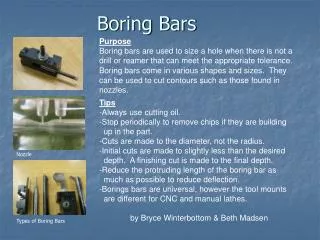
controlled internal diameter refinement. But what characteristics make a boring bar ideal for such a demanding environment? Modern boring bars designed for micro-machining differ significantly from traditional industrial models. Notable advancements include – Miniaturized tool geometry: Standard boring bars are too large for intricate tasks. Micro boring bars feature diameters as small as 0.3 mm, ultra-fine nose radii, and custom shanks for compact setups. These innovations ensure they can access tiny cavities without compromising part integrity. Advanced tooling materials: The longevity and sharpness of the tools are paramount, which largely depend on the materials used. Some of the best materials include Poly Crystalline Diamond (PCD) for abrasive substances, Cubic Boron Nitride (CBN) for hardened steels, and nano-grain carbide for versatile performance, all of which enable micro-boring bars to maintain edge quality and bring about ultra-smooth finishes. Internal damping for stability: At the micro scale, even minor vibrations can be magnified. Damped boring bars utilize internal viscoelastic materials, tuned mass dampers, and anti-vibration coatings to ensure tool stability and minimize chatter, which is essential for achieving mirror-like finishes. Why machine compatibility is equally important Although micro boring tools are compact, the machines they operate on are quite complex. Ensuring compatibility between the boring tools and machines is essential. Important features include: Sub-micron positioning accuracy Minimal thermal expansion High-speed spindles (40,000+ RPM) Integrated tool monitoring systems A proper match between the machine and the tool guarantees that there is no dimensional drift or surface flaws. Challenges faced in micro-boring operations Even though vital, micro boring bars come with a number of challenges. Tool fragility: Small bars can be easily damaged during setup or use. Chip evacuation: Micro-chips may block bores, necessitating high-pressure coolant or air. Runout control: A tool runout of just 2-3 microns can compromise the operation. Heat management: With less material available to absorb heat, thermal deformation poses a constant threat. Tool holding: This requires extremely precise holders with minimal Total Indicator Reading.
Advanced boring bars must incorporate coolant-through designs, ultra-precise shanks, and durable coatings, to address these issues. Innovations expanding the boundaries Read More: How Boring Bars Contribute To Micro-Machining And Ultra-Precision Engineering