Optimizing Collision Detection in Game Design for Enhanced Performance and Realism
Collision detection is a critical component in game design, vital for realism in various gameplay scenarios, from fighting and shooting to driving. This guide explores efficient methods for detecting collisions between objects, utilizing polygon intersection tests and bounding volumes to streamline processing. Techniques include exploiting spatial coherence, maintaining proximity lists, and using approximate distance calculations. It also discusses challenges specific to concave and convex objects, voxel discretization in 3D space, and collision avoidance strategies to improve overall game performance and enhance user experience.

Optimizing Collision Detection in Game Design for Enhanced Performance and Realism
E N D
Presentation Transcript
Collision Detection Game Design
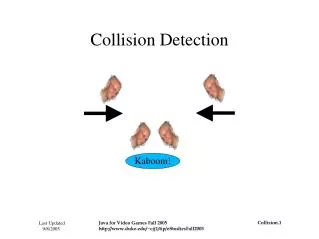
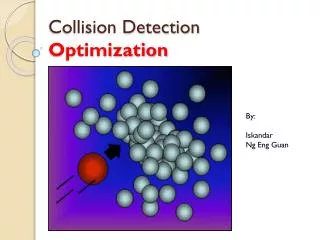
Collision Detection • Essential for many games • Shooting • Kicking, punching, beating, whacking, smashing, hitting, chopping, dicing, slicing, julienne fries… • Car crashes • Expensive • tests!! Game Design
Collision Detection • For each object i containing polygons p • Test for intersection with object j with polygons q • (j > i) • For polyhedral objects, test if object ipenetrates surface of j • Test if vertices of i straddle polygon q of j • If straddle, then test intersection of polygon q with polygon p of object i Game Design
Collision Detection • Efficiency hacks/cheats • Fewer tests: Exploit spatial coherence • Use bounding boxes/spheres • Hierarchies of bounding boxes/spheres Game Design
Bounding Boxes • Axis-aligned vs. Object-aligned • Axis-aligned BBox change as object moves • Approximate by rotating BBox Swept volume Game Design
Collision Detection • Convex objects • Look for separating plane • Test all faces • Test each edge from obj 1 against vertex of obj 2 • Save separating plane for next animation frame Game Design
Collision Detection • Concave Objects • Break apart • Convex hull • Automatic or artist-created Game Design
Collision Detection • To go faster • Sort on one dimension • Bucket sort (i.e. discretize in 1 dimension) • Exploit temporal coherence • Maintain a list of object pairs that are close to each other • Use current speeds to estimate likely collisions • Use cheaper tests Game Design
Collision Detection • Cheaper distance calculation: • Compare against • Approximation: • Manhattan distance - Shortest side/2 Game Design
Collision Detection: Sprites • AND for each pixel in sprites Game Design
Collision Detection • Discretization in 3D • Create a voxel array • Store an ID in each voxel where an object is • Collision where voxel has an ID already • Difficult to determine good voxel size • Huge memory • Hash table -- gives constant time point queries Game Design
Inter-Object Distance • A related problem: • Collision Avoidance • Part of motion planning is to avoid collisions • Many collision detection algorithms take time into account • Estimate Collision Time, distance • www.cs.unc.edu/~geom/collide/index.shtml Game Design