Granularity and Implementation of Pseudo-Trigger Outputs for MUID Calibration
This document outlines the development of pseudo-trigger outputs for the MUID system, detailing the granularity achieved with 4 signals per quadrant across a total of 64 signals (excluding gap 1). We explore the basic implementation of collecting signals into a programmable look-up table to assess quadrant hits from penetrating tracks. Preliminary simulations suggest that soft electrons can complicate detection but highlight its utility for cosmic-ray triggering and MUID calibration. With necessary components and determined collaborators, we are poised to advance the project with a new Ethernet CAMAC controller.


Granularity and Implementation of Pseudo-Trigger Outputs for MUID Calibration
E N D
Presentation Transcript
MUID “Blue-Logic” Trigger Vince Cianciolo Muon Meeting BNL, 12/16/2000
Granularity of Pseudo-trigger Outputs • 4 signals/quadrant/gap • Total 64 (ignore gap 1 for technical reasons)
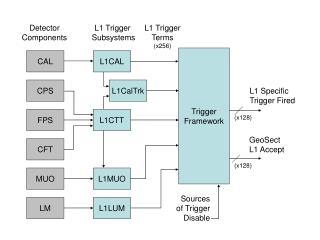
Implementation • Basic idea - collect 16 signals from a quadrant in programmable look-up table. Determine whether each quadrant was hit by a penetrating track (e.g., H and V hits for 3 gaps).
Simulations • Crude simulation shows soft electrons in square hole overwhelm this algorithm for AuAu collisions. • Still definitely useful to provide cosmic-ray trigger for MUID calibration/monitoring. • Still potentially useful for pp and MuTR calibrations (trigger on large-angle tracks).
Status • Modules - have all but level adapters, CAMAC controller. • If we decide to go forward with this, we will buy Ethernet CAMAC controller • For level adapters we have a call out to PHENIX collaborators. I’ve been told that we could easily make such a board if needed. • Programming of MLUs - easy job (mucho E859 experience).