Simplifying Fractions using GCF
This guide explains how to simplify fractions by finding the greatest common factor (GCF) of the numerator and denominator. It defines key terms such as common factor and greatest common factor, helping you understand their importance in fraction simplification. You will learn how to determine the GCF by examining the factors of each number, and how to use it to reduce fractions to their simplest form. By following the step-by-step instructions, you will practice simplifying various fractions effectively and improve your mathematical skills.


Simplifying Fractions using GCF
E N D
Presentation Transcript
Factor • A number that divides evenly into another number.
Common Factor • When two numbers have the same factor.
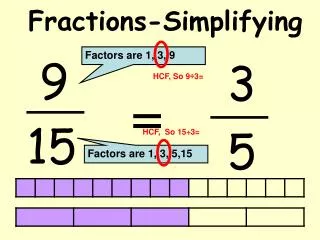
Greatest Common Factor • The greatest common factor is the largest factor between two numbers. 12 = 1, 2, 3, 4, 6, 12 18 = 1, 2, 3, 6, 9, 18 GCF = 6
What is the Greatest Common Factor? 8 = 1, 2, 4, 8 12 = 1, 2, 3, 4, 6, 12 GCF = 4
What is the Greatest Common Factor? 6= 1, 2, 3, 6 18 = 1, 2, 3, 6, 9, 18 GCF = 6
Simplest Form • When the only common factor of the numerator and denominator is 1, the fraction is in simplest form, or it is simplified to lowest terms. 3 1 3 ÷ = 4 1 4
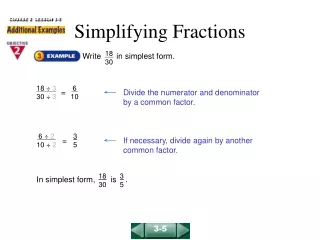
How to Simply a Fraction • Find the greatest common factor of the numerator and the denominator and divide both by that number.
Simplifying a Fraction: 2 12 6 ÷ = 18 6 3
Simplify: 9 3 3 ÷ = 21 3 7
Simplify: 12 4 3 ÷ = 4 5 20
Simplify: 10 5 2 ÷ = 15 5 3
Simplify: 10 2 5 ÷ = 16 2 8
Simplify: 12 4 3 ÷ = 16 4 4
Simplify: 3 3 1 ÷ = 12 3 4
Simplify: 2 2 1 ÷ = 4 2 2
Simplify: 6 3 2 ÷ = 9 3 3
Begin working on your Assignment!