Tackling Fuel Poverty and Climate Change: Strategies for Energy Efficiency in Housing
This update explores the intertwined issues of fuel poverty and climate change, focusing on strategies to improve energy efficiency in housing. Dr. Brenda Boardman highlights the challenges faced by the fuel poor, particularly the elderly, in accessing affordable energy. With fuel prices surging and real incomes declining, it's vital to implement area-based approaches to upgrade housing. These strategies involve working closely with community groups and utilizing trusted local installers to ensure all households benefit from energy-efficient solutions.

Tackling Fuel Poverty and Climate Change: Strategies for Energy Efficiency in Housing
E N D
Presentation Transcript
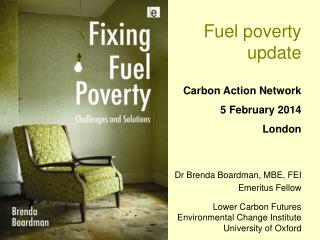
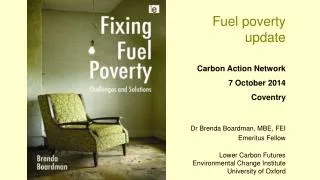
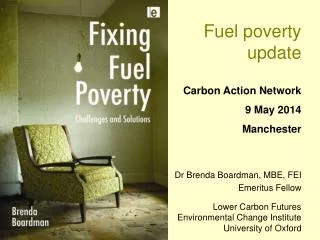
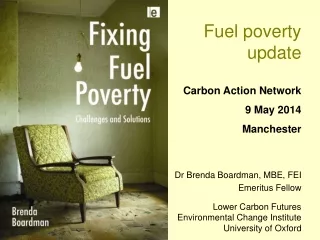
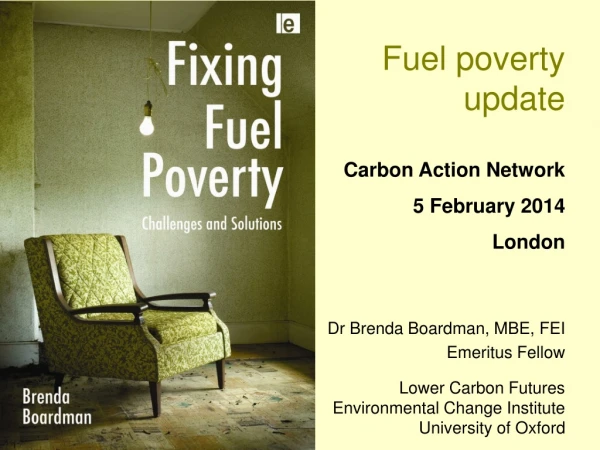
Fuel poverty update Carbon Action Network 5 February 2014 London Dr Brenda Boardman, MBE, FEI Emeritus Fellow Lower Carbon Futures Environmental Change InstituteUniversity of Oxford
Résumé • 31,100 EWD last winter • Fuel price increase of 10% (£120) reduced to £50 increase by prolonging ECO • Real income of the poorest people declining • Fuel poor are hard (and expensive) to identify
Energy efficiencyEnglish housing (SAP09) 2001 2011 Social sector 52.1 62.9 Private sector 45.3 55.4 Average 46.7 56.7 English Housing Survey, Homes 2011 (2013) DCLG Table 4.1
Rates of insulation EBR and ACE (2014), Fuel poverty: 2014 update, p7
Households in fuel povertyEngland EBR and ACE (2014), Fuel poverty: 2014 update, p3-4
Fuel poor pensioners • 32% of all households • 25% of fuel poor (new definition) • 49% of fuel poor (old definition 2013-14 • Decreasing with new definition • Increasing with old
Income + housing Low income High income Energy inefficient housing Energy efficient housing
Local Authority tasks • HHSRS / minimum standards • Health and Wellbeing Boards • HECA • Prepare for privately-rented, no F & G • Landlord register • Complete EPC coverage • Decent Homes 2
Area based approaches • Low Carbon Zones (Warm Zone +) • One per local authority • Local authority co-ordinates • Works closely with community groups • Street-by-street • SAP 81 or better (A/B on EPC)
Working with communities • Community groups act as go-between • Protect and speak for low-income residents • Arrange advice and non-standard measures • Are trusted • Help incorporate all households
Synergies: fuel poverty and climate change • Poorest people concentrated in worst housing • Upgrade to super energy-efficient, low-carbon housing • Fuel poverty = SAP 81 @ 6,500 pa per local authority • Climate change = SAP 100 @ 750,000 pa
www.eci.ox.ac.uk Thank you
Workshop questions Assumes some money available • Area-based approaches – what size? COA as in NI (150 households) • How to link with local community groups? • How to employ local installers? • Property owner vs occupant? • How to link with HECA and HHSRS?