Understanding Torque and Balance in Sticks: A Practical Problem Set
This problem set explores the concepts of torque and balance using practical examples. It demonstrates how to relate masses and distances in order to achieve equilibrium on a stick. Key equations include the calculation of torque (t = rF) and specific relationships among masses and distances (m1r1 + m3r3 = m2r2 + m4r4). An example calculates the required mass (m2) to maintain balance, using given values for other masses and distances. A discussion on the ease of turning a screw with various screwdriver handle sizes is also included.

Understanding Torque and Balance in Sticks: A Practical Problem Set
E N D
Presentation Transcript
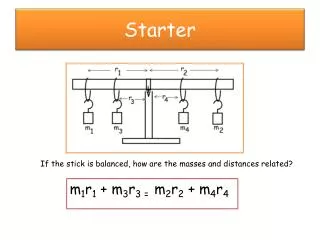
Starter If the stick is balanced, how are the masses and distances related? m1r1 + m3r3 = m2r2 + m4r4
Practice – Torque Problem Set • t = rF • For the stick; • t = mgr • ( units = N.m )
Example m1 = 50grams, r1 = 30cm, and r2 = 20cm. Find m2. Find the clockwise torque. Find the counter-clockwise torque. 1. m1r1=m2r2 so m2 =m1r1 /r2 = 50(30)/20 = 75 grams. 2. t = rF = m2gr2 = (.075kg)(9.8 m/s2)(.20m) = .147 Nm 3. If balanced, counter-clockwise torque = the clockwise torque =.147Nm
Exit To turn a stubborn screw, is it easier to use a screwdriver with a wide handle of a narrow handle? Explain.