Understanding Matrices: Definitions, Operations, and Properties
This comprehensive guide explores the fundamental concepts of matrices, including their definitions, representations, and operations. Discover the structure of matrices, where each element is organized in rows and columns. Learn about critical operations such as scalar multiplication, matrix addition, and multiplication, and understand the importance of the transpose and inverse. Additionally, delve into properties like the identity matrix and rank. This resource is essential for anyone studying linear algebra and its applications in various fields.


Understanding Matrices: Definitions, Operations, and Properties
E N D
Presentation Transcript
Definitions • A matrix is an m x n array of scalars, arranged conceptually as m rows and n columns. • m is referred to as the row dimension • n is referred to as the column dimension • If m=n, the matrix is a square matrix.
Representations • Each element of array A is represented as: • Array A can thus be represented as: • The transpose of A is: • The column matrix of A is: • The corresponding row matrix is:
Matrix Operations • Scalar-matrix multiplication • Matrix-matrix addition: The sum makes sense only if the two matrices have the same dimensions. • Matrix-matrix multiplication The matrix-matrix product is defined only if the number of columns of A is the same as the number of rows of B.
Row-Column Matrices vs. Transpose • We may represent any point in a space as a row or column matrix (or vector). • Transpose
Inverse • Matrix A is invertible if there exists a B such that: AB = I • Such matrix A is said to be nonsingular and B can denoted by A-1. • The inverse of a square matrix A exists if and only if |A|, determinant of A, is nonzero.
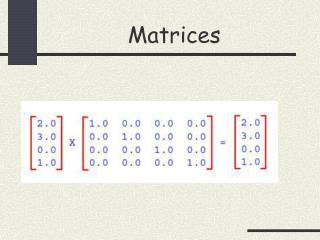
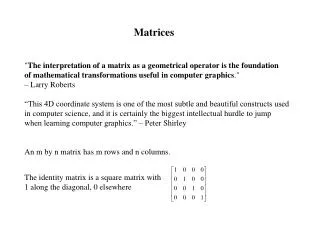
Identity Matrix • The identity matrix I is a square matrix with 1’s on the diagonal and 0’s elsewhere: • AI = A, IB = B
Rank The row (column) rank is the maximum number of linearly independent rows (columns).
Rank (II) • For an n x n matrix, if it is nonsingular, i.e., both of its row rank and column rank are n, the matrix has rank of n.
![[MATRICES ]](https://cdn4.slideserve.com/144276/matrices-dt.jpg)