The Revolution of 3D Printing: Transforming Design and Production
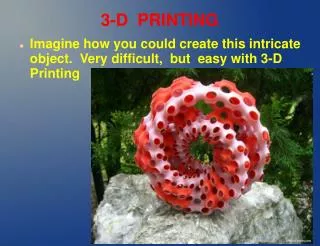
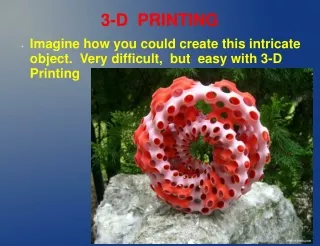
3D printing, pioneered by Charles Hull in 1986, has evolved from a prototyping tool into a transformative technology with vast applications. This process allows designers to create complex objects layer by layer, with outputs ranging from everyday items like cups and clothes to essential medical instruments. The advantages of 3D printing include mass production efficiency, customization potential, and the ability to address shortages in critical resources, such as organs for transplants or food in underserved regions. The future of 3D printing holds promise for solving global challenges.


The Revolution of 3D Printing: Transforming Design and Production
E N D
Presentation Transcript
3-D Printing Brady Roelofs
Background • Original Purpose: Prototypes • Charles Hull • Founder of 3D Systems • 1986
Technology • Different Steps • Design on Computer • Process • Layers • Finishes
Other Products • Instruments • Cameras • Cups • Clocks • Clothes
Advantages Main Advantages: • Mass Production • Customization • Substitute for Scarce Items
The Future • Medical • Save Lives (Organs, Transplants) • Food Production • Third-World countries (world hunger) • Scarce Resources
References • "How 3-D Printing Actually Works” Mashable. N.p., n.d. Web. 12 Nov. 2013. http://mashable.com/2013/03/28/3d-printing-explained/ • Evans, Hugh “3-D Printing: The Game Changer” T.Rowe Price, 12. May. 2012 http://individual.troweprice.com/public/Retail/Planning-&-Research/Connections/3D-Printing/The-Game-Changer • D'Aveni, Richar A. "March 2013." 3-D Printing Will Change the World. Harvard Business Review, n.d. Web. 12 Nov. 2013. http://hbr.org/2013/03/3-d-printing-will-change-the-world/ • Chung, Becky. "TED Blog." TED Blog A 3D Printed Future 10 Surprising Things We Could See Printedsoon Comments. N.p., n.d. Web. 12 Nov. 2013. http://blog.ted.com/2013/07/29/a-3d-printed-future-10-surprising-things-we-could-see-printed-soon/