Download
1 / 19
190 likes | 300 Vues
This assignment focuses on essential concepts in geometry, including measuring line segments and angles. It covers key postulates, such as the Ruler Postulate and Segment Addition Postulate, to help students understand the distance between points and how to find the lengths of segments. Additionally, it addresses angle measurements, classifications of angles, and the Angle Addition Postulate. Through practical examples and problem-solving tasks, students will strengthen their geometric reasoning and skills in measuring and comparing segments and angles.

E N D
MEASURING SEGMENTS AND ANGLES
Assignment Page 29 - 30 2 – 30 even 31, 32, 34, 36, 42, 44, 46, 70, 72, 76, 78
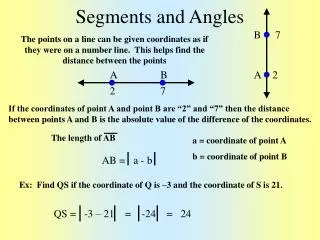
Ruler Postulate 1- 5 The distance between any two points is the absolute value of the difference of the corresponding numbers Example: Length of AB is a – b which in this Case would be 2 – 5 Or the - 3 which is 3 B A
Congruent segments segments of the same length A B C D AB = CD or AB = CD The two tick marks is a way of showing that the two segments are congruent
A B C D E Compare CD and DE CD = -2 – 0 = -2 = 2 DE = 0 – 2 = - 2 = 2 CD = DE
Segment Addition Postulate 1- 6 If three points A, B, and C are collinear and B is between A and C, then AB + BC = AC Example : From previous CD = 2 and DE = 2 2 + 2 = 4 CE = -2 -2 = -4 = 4 A B C D E
4x – 202x + 30 E F G EG = 100. Find the value of x, then EF and FG EF + FG = EG (4x – 20 ) + ( 2x + 30 ) = 100 6x + 10 = 100 6x = 90 x = 15 EF = 4x – 20 = 4(15) – 20 = 40 FG = 2x + 30 = 2(15)+ 30 = 60
3x +1 2x-2 E F G EG = 64 Find EF and FG
Midpoint of a Segment point that divides the segment into two congruent segments We are bisecting the segment A B C AB = BC
5x + 3 7x – 9 P T Q Using midpoint T is midpoint, find PT, TQ and PQ PT = TQ definition of midpoint 5x + 3 = 7x – 9 substitution 5x + 12 = 7x add 9 to each side 12 = 2x subtract 5x from each side 6 = x divide each side by 2 PT = 5x + 3 = 5(6) + 3 = 33 TQ = 7x – 9 = 7(6) – 9 = 33 PQ = 66
Angles two rays with the same endpoint rays are the sides of the angle the endpoint is the vertex vertex rays
A Naming angles D 1 2 B <1 Use the number <ADB <BDA Name the two sides with the vertex in the middle If we were referring to <ADC we could also say that this was <D C
Measuring Angles Use a Protractor Classify Angles according to their measurement acute less than 90 degrees 0 < x < 90 x
Right angle exactly 900 x = 90 Obtuse angle greater than 900 but less than 1800 90 < x < 180
Straight angle two opposite rays 1800
Angle Addition Postulate If point B is in the interior of < AOC, the m<AOB + m<BOC = m <AOC In other words, if you have two small adjacent angle they will add up to the larger angle B A C 0 If < AOC is a straight angle, the m<AOB + m<BOC = 180 B O A C
Try this! If m<DEG = 145, find the m<GEF G D E F 145 + x = 180 x = 35 m< GEF = 350
Congruent Angles Angles that has the same measure These angles can be marked to show they are congruent