The Impact of Reconstruction and the Ku Klux Klan on African American Rights
This project explores the contrasting goals of Radical Reconstruction and President Johnson's Plan, highlighting the efforts to secure African American rights through voting, citizenship, and the abolition of slavery. It examines the actions of the Ku Klux Klan, which aimed to suppress African American power in communities, businesses, and churches. The project includes a T-chart comparing these historical approaches and a visual representation of the cycle of poverty faced by sharecroppers after the Civil War, illustrating the socio-economic challenges that arose during Reconstruction.

The Impact of Reconstruction and the Ku Klux Klan on African American Rights
E N D
Presentation Transcript
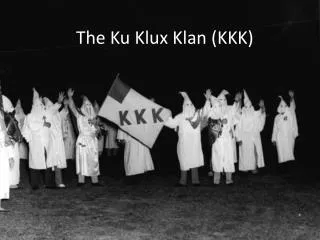
The Ku Klux Klan • GOAL: Keep African Americans from gaining power • Voting, businesses, churches, etc. • http://www.history.com/videos/the-kkk#the-kkk
Make a T-Chart. Put each of these ideas on the correct side of the tchartfor Radical Reconstruction and Johnson’s Plan. Use pages 552-555 in your book. • Southern states allowed to organize new governments and elect representatives • States must disband state government • States must pass 13th and 14th amendment • States are required to abolish slavery • African American men allowed to vote • States are required to abolish slavery • States must pass the 13th amendment
Radical Reconstruction T Chart Radical Reconstruction= Radical Republicans = CONGRESS (Make change) ANDREW JOHNSON (Make friends)
The Civil Rights Act of 1866 • Granted citizenship rights to African Americans and guaranteed civil rights of all people except Native Americans • CONGRESS (RADICAL REPUBLICANS) WANTED THIS. JOHNSON DID NOT. • Johnson tried to VETO the bill • Was an attempt to outlaw black codes and led to the 14th amendment
Cycle of Poverty • Planting the crop: white landowners give land, seed, and tools in exchange for a share in the crop. Sharecroppers buy on credit. • Harvesting the crop: Sharecroppers give landowner the crop, the landowner sells it and takes his share • Cycle of debt: Sharecroppers OWED more than they EARNED and gave up more and more of the crop to the landowner
You will create images to represent each level in the cycle of poverty • Use the cycle we created in class, your book (page 560) to put these in your notebooks. • Your images must be colored (10 points: images for each step that represent the steps)