
Mastering Arrays in Java Programming: Properties, Processing, and Examples
E N D
Presentation Transcript
Arrays • The concept of arrays • Using arrays • Arrays as arguments • Processing an arrays data • Multidimensional arrays • Sorting data in an array • Searching with linear or binary search
Why arrays • Consider a program to find the average of a set of numbers. • How could we do this. • We could read each number one at a time • Sum all of the values together and keep a count to compute the average • How do we then find the median value. The actual value closes to the average?
Consider a list of 3 numbers. • Number1=5 • Number2=10 • Number3=7 • Which is the median. How did we find that value? • What would the code look like?
The median sum = n1+n2+n3 ave=sum/3 If (Math.abs(ave-n1) < Math.abs(ave-n2) && Math.abs(ave-n1) < Math.abs(ave-n3) ) median = n1 Else …
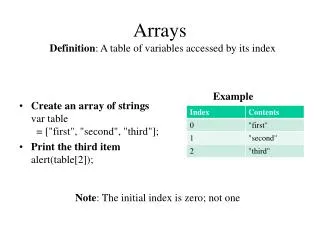
Complex for three number even more complex for more • Arrays to the rescue. • Arrays can store a list of values under the same name. • Each value can be access individually using a subscript or index value or variable.
Array storage • The array named Data stores 5 values. • Each element in a array can be used in out program just like an other variable of that type. • Data[0]=5; • Sum=Data[0]+Data[1]
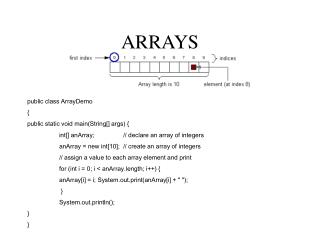
Making an array • Declaring an array • int[] Data; • int Data[]; • Allocating space for an arrays elements • Arrays are reference type variable in Java so space must be allocated for them • int[] Data =new int[100]; • Or ---- • int[] Data; • Data =new int[100]; • The new key word is required when making space for reference type data
Properties of arrays • Indexing begins at zero • The .length property returns the number of elements in the array. • So Data.length would be 100 • It is an error to access a data element in a array that is not defined. This will result in a logic error that can be difficult to debug.
Processing an array • A loop is used to process an array • Display value • Sum values • Initialize values • Load values For (int x=0;x< Data.length;x++) Data[x]=0;
Processing arrays • When working with arrays it is common practice to create a variable to keep track of the actual valid data items in the array. • Arrays may be declared at an arbitrarily large side the actual count of valid data elements in the array may be less. • If this is the case then using the arrays length property is not valid. For (int x=0;x< Data_cnt;x++) System.out.println(Data[x]);
Initialization lists • String[] Month ={“”,”Jan”,”Feb”,…”Dec” }; • System.out.println(Month[3]); • int[] Data={ 5,10,7,12,2 }; • Can only be done when the array is declared or allocated • So this can be done later in the program • Data = new int[] { 5,2,5,3,1 };
Lets make an example • Write a program to collect grade scores from the user and store into an array. • Write a loop to total the scores • Write a loop to find the largest value • Write a loop to count the number of time the largest value is entered.
Sample sum=0; // compute the total for(i=0; i<data_cnt;i++) sum=sum+data[i]; JOptionPane.showMessageDialog(null,"The sum is"+sum,"Results", JOptionPane.PLAIN_MESSAGE); largest = 0; // find the largest value for(i=0; i<data_cnt;i++) { if (data[i] > largest) largest = data[i]; } JOptionPane.showMessageDialog(null,"The largest is"+largest,"Results", JOptionPane.PLAIN_MESSAGE); largest_cnt=0; // Count the number of times the largest value appears in the list for(i=0; i<data_cnt;i++) { if (data[i] == largest) largest_cnt ++; } JOptionPane.showMessageDialog(null,"The count of largest is"+largest_cnt,"Results", JOptionPane.PLAIN_MESSAGE); System.exit(0); } } import javax.swing.*; public class grades { public static void main (String arg[]) { String snum; int num1=0; int i,sum; int largest; int largest_cnt; int[] data = new int[100]; int data_cnt=0; // read in the numbers while (( num1>=0 ) && (data_cnt<100)) { snum = JOptionPane.showInputDialog("Enter a Number?"); num1=Integer.parseInt(snum); data[data_cnt] = num1; data_cnt++; } data_cnt--; // print the list for(i=0; i<data_cnt;i++) { System.out.print(" " + data[i] + " "); } sum=0; // compute the total for(i=0; i<data_cnt;i++) sum=sum+data[i]; JOptionPane.showMessageDialog(null,"The sum is"+sum,"Results", JOptionPane.PLAIN_MESSAGE);
Using arrays in an assignment • newlist = list • This assignment would seem like it should copy the values from list to newlist. • It does not. Remember that an array is a reference type data. So this actually causes newlist and list to reference that same data. List elements list newlist
To copy the data in an array • We must create a loop • Then in the loop we must copy each element from one array to the destination. List elements list newlist List elements
Passing arrays as arguments • Arrays are passed by reference to a method. • So changes to the arrays elements in the method are shared by the calling method.
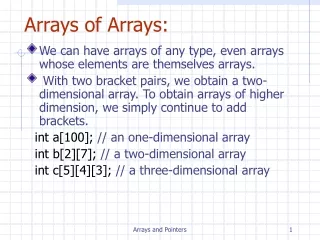
Multidimensional arrays • Arrays can have more then one index. • These are called multidimensional. • So Int[][] data; • Or Int data[][]; • Declare a two-dimensional array • Grid = new int[5][5]; will define the memory for the array 5 by 5 in size
Searching an array • A form of array processing • Linear search or sequential search • Check each element looking for the data until it is found. • Very simple algorithm. • Binary search • Only works for ordered lists. Divide and conquer. • Check the middle of the list is it high or low. Then divide the search range in half and continue this process. • Much faster then a sequential search
Sorting arrays • Given an array of data order the data in some way. • Maybe ascending or descending order. • Maybe numeric or Alphabetic order • The most basic form or sorting involved nested loops with comparisons and swamps
The code for(out=0; o<datasize;out++) { for(in=out; in<datasize;in++) { If (data[out]<data[in]) { // swap data[out] and data[in] temp=data[out]; data[out]=data[in]; data[in]=temp; } } }
Let look at the same code • It is actually a little different then the process we described. • It does work it is not optimal • What could be different???
An intuitive sort algorithm • Try to find the lowest value in a list then swap it with the value in the first array slot. • Then find the next lowest value in the list and try to swap it with the second array slot. • Continue this process for each array slot up to the end of the list.
Homework • TBD