Plant Responses and Adaptations
100 likes | 217 Vues
This text explores how plants "talk" through hormonal communication, detailing various hormones such as auxins, cytokinins, gibberellins, and ethylene that influence growth patterns, movement, and responses to environmental stimuli. It examines tropisms, including phototropism and gravitropism, and discusses dormancy in plants in response to seasonal changes. Additionally, it highlights adaptations in aquatic plants and xerophytes, showcasing their unique structures that aid in survival. The content is essential for understanding plant biology and ecology.


Plant Responses and Adaptations
E N D
Presentation Transcript
Plant Responses and Adaptations Ms. Moore 9/19/12
How do plants “talk”? • Hormones: substance produced in one part of an organism that affects another part of the same individual • In plants, hormones are chemical substances that control a plant’s growth patterns, development, and response to environmental conditions. • Target cell/tissue: contains a receptor that hormone binds to • This is the part that is affected by the hormone.
Plant Movement • Phototropism: tendency of a plant to grow towards light • Auxin: stimulates elongation; located in apical meristem • Gravitropism: response of plant to force of gravity
Auxin and Branching • Auxins also regulate cell division in meristems. • Lateral bud: meristematic area on the side of a stem that gives rise to “branches” • Apical dominance: the closer a bud is to the stem’s tip, the more its growth is inhibited; this is due to auxin moving out from the apical meristem • Snipping the tip will also remove the inhibiting auxin affect, giving you a rounder, fuller plant. • Herbicides: auxin-like compounds that are toxic to plants
Hormones con’t • Cytokinins: plant hormones that are produced in growing roots and developing fruits and seeds • Cytokinins stimulate cell division and the growth of lateral buds, and cause dormant seeds to sprout. • Gibberellins: growth-promoting substance • Gibberellins produce dramatic increases in size, particularly in stems and fruit. • Ethylene: stimulates fruits to ripen • Supermarkets use this to keep fruits on the shelves longer.
Plant Responses • Tropisms: responses of plants to external stimuli • Gravitropism • Phototropism • Thigmotropism: touch
Seasons • Photoperiodism: plant responses to periods of light and dark • Responsible for the timing of seasonal activities such as flowering and growth. • Short-day plants • Chrysanthemums and poinsettias • Long-day plants • Spinach and irises • Phytochrome: plant pigment that is responsible for photoperiodism; absorbs red light
Winter’s Coming • Dormancy: growth and activity stop • As cold weather approaches, deciduous plants turn off photosynthetic pathways, transport materials from leaves to roots, and seal leaves off from the rest of the plant. • Abcission layer: seals leaf off from vascular system • Before long, the leaf falls towards the ground, a sign that the tree is ready for winter. “Winterized”
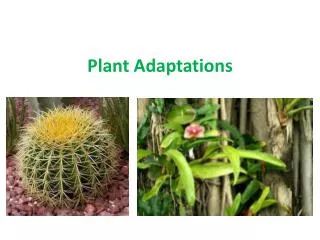
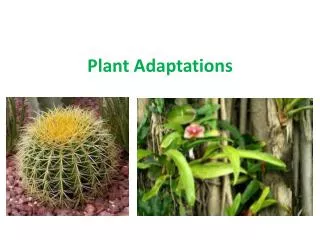
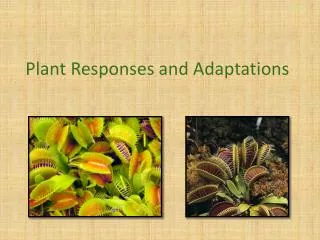
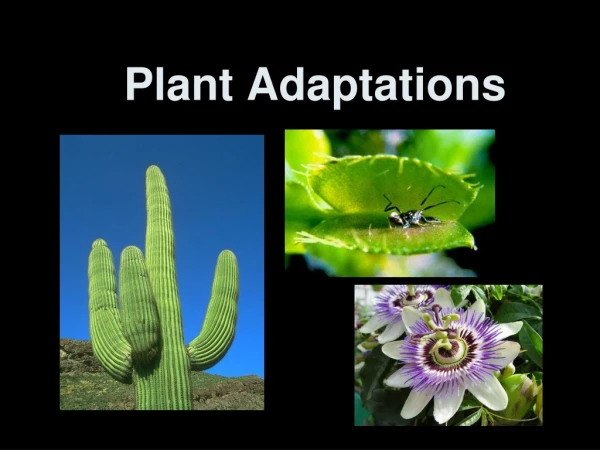
Adaptations • Aquatic plants have tissues with large air-filled spaces through which oxygen can diffuse. • Xerophytes: plants that live in the desert biome • Adaptations include extensive roots, reduced leaves, and thick stems that can store water. Why? • Plants that have specialized features for obtaining nutrients include carnivorous plants and parasites. • Epiphytes: plants not rooted in soil, but grow directly on the bodies of other plants • Many plants defend themselves against insect attack by manufacturing compounds that have powerful effects on animals.