Download
1 / 7
70 likes | 200 Vues
Recent advancements in giant-impact models reveal that lunar material may stem from various depths in the proto-Earth's mantle or from colliding half-Earths. This complexity challenges traditional views of lunar formation, raising philosophical concerns about the requisite sequence of events. Notably, new dynamical models lack the simplicity of canonical scenarios, sparking debate about the probabilistic nature of these multi-stage processes. The current investigations into the moon's origin emphasize an unexpected level of intricacy in understanding our celestial neighbor.

E N D
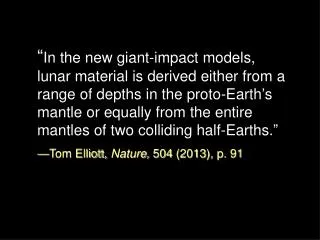
“In the new giant-impact models, lunar material is derived either from a range of depths in the proto-Earth’s mantle or equally from the entire mantles of two colliding half-Earths.” —Tom Elliott, Nature, 504 (2013), p. 91
“New dynamical models that can produce the Moon from the proto-Earth do not have the inherent simplicity of the canonical giant impact scenario.” —Tom Elliott, Nature, 504 (2013), p. 90
“The sequence of conditions that currently seems necessary in these revised versions of lunar formation have led to philosophical disquiet.” —Tom Elliott, Nature, 504 (2013), p. 90
“With the nested levels of dependency in a multi-stage model, is the probability of the required sequence of events vanishingly small?” —Sarah Stewart, Nature, 504 (2013), p. 91
“The current detailed interrogation of lunar origin may demand answers that have an unexpected level of complexity.” —Sarah Stewart, Nature, 504 (2013), p. 91
Ezer “assistant in the context of a military ally or source of reinforcement for the completion of an assigned task” —Carl Schultz
“Put on God’s armor so that you can make a stand against the tricks of the devil. We aren’t fighting against human enemies but against rulers, authorities, forces of cosmic darkness, and spiritual powers of evil in the heavens.” (Eph. 6:11-12 CEB)