Understanding Numerical Methods in Nonlinear Least Squares and Time Integration Techniques
Join us for an extra class this Friday from 1-2 PM where we will delve into key concepts of nonlinear least squares and time integration. We will discuss the quasi-Newton methods, focusing on Taylor series applications for functions, and explore gradient and Hessian structures. Additionally, we'll analyze Forward Euler methods, including their accuracy and convergence, as well as how to effectively solve linear ordinary differential equations. This session is crucial for anyone looking to deepen their understanding of numerical methods in computational mathematics.

Understanding Numerical Methods in Nonlinear Least Squares and Time Integration Techniques
E N D
Presentation Transcript
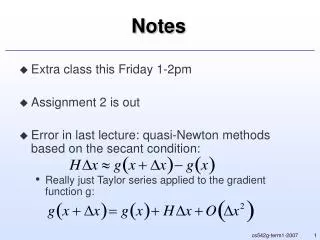
Notes • Extra class this Friday 1-2pm • Assignment 2 is out • Error in last lecture: quasi-Newton methods based on the secant condition: • Really just Taylor series applied to the gradient function g: cs542g-term1-2007
Nonlinear Least Squares • One particular nonlinear problem of interest: • Can we exploit the structure of this objective? • Gradient: • Hessian: cs542g-term1-2007
Gauss-Newton • Assuming g is close to linear, just keep the JTJ term • Automatically positive (semi-)definite:in fact, modified Newton solve is now a linear least-squares problem! • Convergence may not be quite as fast as Newton, but more robust. cs542g-term1-2007
Time Integration • A core problem across many applications • Physics, robotics, finance, control, … • Typical statement:system of ordinary differential equations,first orderSubject to initial conditions: • Higher order equations can be reduced to a system - though not always a good thing to do cs542g-term1-2007
Forward Euler • Derive from Taylor series: • Truncation error is second-order • (Global) accuracy is first-order • Heuristic: to get to a fixed time T, need T/∆t time steps cs542g-term1-2007
Analyzing Forward Euler • Euler proved convergence as ∆t goes to 0 • In practice, need to pick ∆t > 0- how close to zero do you need to go? • The first and foremost tool is using a simple model problem that we can solve exactly cs542g-term1-2007
Solving Linear ODE’s • First: what is the exact solution? • For scalars: • This is in fact true for systems as well, though needs the “matrix exponential” • More elementary approach:change basis to diagonalize A(or reduce to Jordan canonical form) cs542g-term1-2007
The Test Equation • We can thus simplify our model down to a single scalar equation, the test equation • Relate this to a full nonlinear system by taking the eigenvalues of the Jacobian of f: • But obviously nonlinearities may cause unexpected things to happen: full nonlinear analysis is generally problem-specific, and hard or impossible cs542g-term1-2007
Solution of the Test Equation • Split scalar into real and imaginary parts: • For initial conditions y0=1 • The magnitude only depends on a • If a<0: exponential decay (stable)If a>0: exponential increase (unstable)If a=0: borderline-stable cs542g-term1-2007